We have run two articles recently on the problems of increasing traffic - and, in particular, the size of some of the commercial vehicles. Following this we have had a lot of feedback, some of which has been published. The general feeling has been one of broad support for our view that the roads could no longer cope with the volume and size of the traffic. One letter was mildly abusive towards both this writer and also residents of the Citadel, while another pointed out that Rye had "blown it" by objecting to a previous plan for a by-pass. This last reader has a point.
In the 1980s there was a proposal put forward by the Department of Transport for a road link between Ashford and Hastings which would follow the existing railway line. Part of this road was built (from Ashford to Brenzett) but the plan for the section down to Rye was withdrawn due, it would appear, to fierce opposition by Rye residents under the banner of the Rye Action Group, the argument being that it would split the town in two - not entirely true, since 80% of the town would still be south of the road. In the long run, however, this made little difference as, by 1996, funding for further road building in the Rye area was withdrawn.
In a 1997 report by Rother Environmental Group (REG), it was stated that the road problem is not caused by cars or light commercial vehicles but by the quantity of HGVs (then a maximum weight of 35 tons, but now in excess of 40 tons) and this still seems to be more or less the case. A recent, and admittedly unscientific, survey that I carried out showed that cars and light vans could negotiate the narrow and winding parts of the A259 quite satisfactorily and although the road is undoubtedly very busy, this type of vehicle tended to go through without problem and with few or no hold-ups.
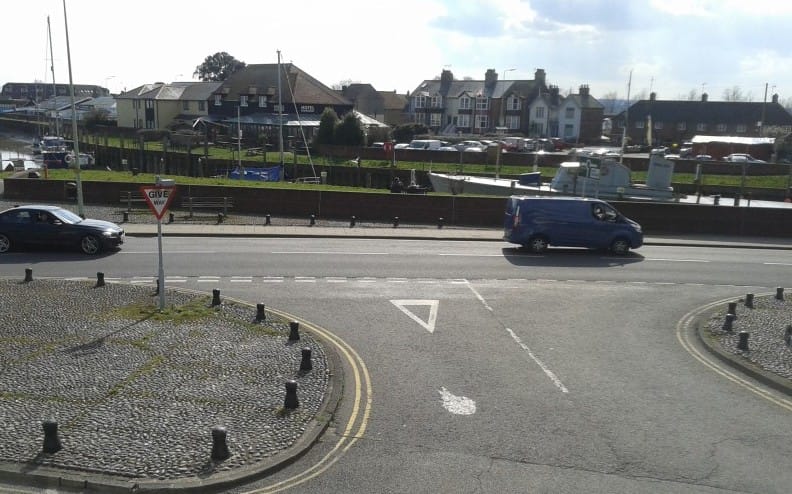
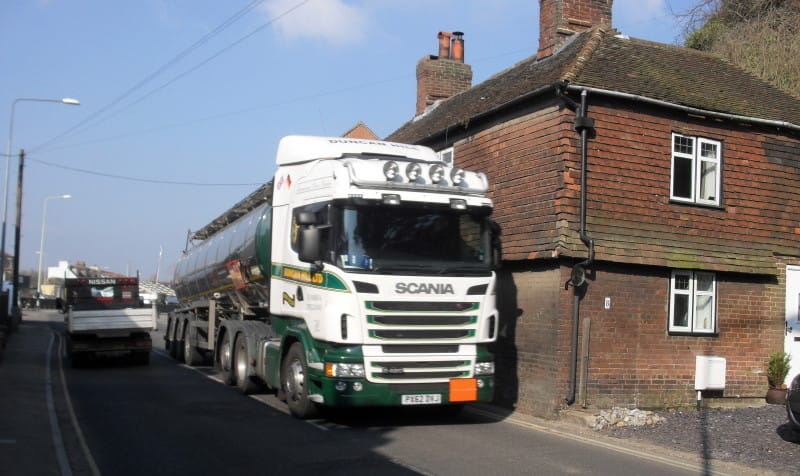
The problem, as REG found, and as we see demonstrated on an hourly (if not minute by minute) basis today, is the HGV. When the A259 was first conceived (and long before it had a name or number) a heavy load was a few hundredweight on the back of a cart pulled by a horse. Today it is a 40-ton articulated, gravel-carrying lorry passing within inches (and I do mean inches) of houses in South Undercliff and Fishmarket Road, and yet the road has remained largely unchanged - yes it is, of course tarmacked and there are pavements (but not everywhere), but the width hasn't changed and neither have the sharp bends which so often cause chaos when two large vehicles approach from opposite directions.
So what's the answer?
One suggestion has been a straight new road from Ashford direct to Brighton and which would pass some 10 miles north of Rye with all the area south of it being declared a national park. A Utopian idea, but sadly quite impractical. No government - not even a capital-spending Corbyn one - would fund it, and even if they did the myriad of public enquiries together with the usual crowd of long haired, bearded, scruffy tree-hugging Swampies would see to it that the current generation, at least, were all six feet under by the time the first sod was turned.
Another suggestion might be to resurrect the road-by-the-railway plan, although I imagine that might activate the same level of opposition from Ryers as it did the last time it was proposed (although if well screened and sound-insulated it might prove one of the more viable long term options).
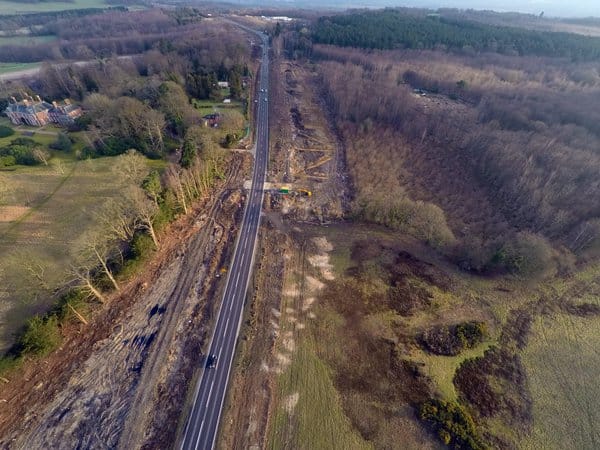
One thing that could, of course, be done immediately would be to declassify the A259 as a trunk road thus, hopefully, removing it as a preferred route from lorry drivers' sat navs. Another option would be to complete the widening of the A21 to allow for dual carriageway through to Hastings which could join up with the new Bexhill by-pass.
This would be good for Hastings, and heavy traffic could then use the M20, M26 and (with a new junction) on to the A21 back to the coast road. Restrictions on the A259 would ensure that HGVs, other than those originating or ending their journey in Rye, could not use it and the time taken to travel from Ashford to, say, Brighton would probably be no longer than taking the current slow and winding route along the Marsh and via Rye. The cost of this could be balanced against the economic benefit brought by improved communications to Hastings together with the environmental benefit to Rye, Winchelsea and Icklesham.
And the best bit - not a single great crested newt, three-toed frog or dormouse need be left without a habitat to call home.
[I am indebted to the authors of the 1997 Rye Environmental Group report for some of the historic facts in this article]
Photos: John Minter and Library