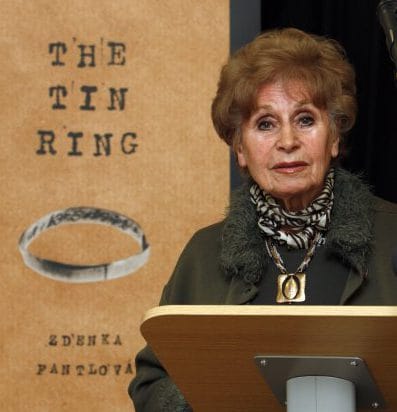
The author, actress, music educator, and recording artist, Ann Rachlin MBE has lived in Icklesham since 1978. To mark Holocaust Memorial Day on January 27, we print this story of Ann's extraordinary meeting with Zdenka Fantlova, a holocaust survivor, and author of 'The Tin Ring', an account of how a seventeen-year-old girl survived the horrors of six Nazi concentration camps, including Auschwitz and Bergen-Belsen.
How I came to record 'The Tin Ring' for the blind
A suitcase - a simple suitcase with a name and a number scrawled on it. Neil Molloy stared at it. It seemed to stand out from all the hundreds of others piled high in the Holocaust Museum in Auschwitz concentration camp. Maybe it was the smell of old leather, the dust, the enormity of the significance of this huge pile of suitcases that prompted him to take a photograph of it. Neil is a sculptor in the university town of Durham. On his return home, he looked at the photograph and decided to make a stone copy of that suitcase. When it was finished, he carved the name and the number - just as it was on the original - Zdenka Fantlova - S716
Henry Dyson, keeper of fine arts at the University of Durham was told about the suitcase and went to see it in Neil's studio. The simplicity and the starkness of its message moved him greatly. Henry decided that this solitary stone suitcase should be the centrepiece of a Holocaust Memorial. So he commissioned Neil to add a bag of clothes, a book, a shoe, an abandoned umbrella, scattered at random on the grass in the garden of St Aidan's College. This simple uncluttered memorial serves to remind the generations of students of what happened in the Holocaust and, we hope, inspires them to make sure that it never happens again.
Zdenka's suitcase has become an emblem- a symbol of strength of will and determination to survive against all odds. It is unique - and yet it is one of millions. All old now - all bearing the name of the owner - a number which matched a tattoo on an arm. One of thousands of suitcases now stacked in holocaust museums all over the world - an emotive reminder of genocide - the destruction of human beings - not only Jews, but homosexuals who had to wear a pink triangle, gypsies, disabled persons, Jehovah's Witnesses - anyone deemed unfit to be a member of Hitler's master race.
A suitcase! Isn't it strange how a suitcase - a transient frail receptacle, can become the guardian of memories? A veritable museum of historical treasures. A custodian of art and music.
Without that suitcase, I would never have recorded the wonderful little book called 'The Tin Ring' for the blind. Without that suitcase, I would never have known its author, Zdenka Fantlova, I would not have written to her, met her, and come to love and admire her. Without that suitcase, I would not have the privilege and honour of calling her my friend. How did it happen?
I first saw the stone suitcase when I stood in a group on the grass at St Aidan's College in Durham on Sunday, October 12, 2014. Next to it was a bag of clothing, a book, a dilapidated umbrella - all carved in stone by Neil Molloy. Representatives of the university, the faculty, the students, Christians, Muslims, Jews - clergy of all faiths, all watched in silence as the Jewish Prayer for the Dead was read. It was deeply moving. Yet one important person was missing. The owner of that suitcase, Zdenka Fantlova the author of The Tin Ring.
On a flight to Switzerland, Zdenka had seriously injured her arm which necessitated immediate surgery. So she was not well enough to come to Durham for the dedication ceremony. Although I did not know her, I keenly felt her absence and decided to write to her and describe the event to her. A few weeks later, she telephoned me.
“Were you pleased with the stone replica of your suitcase?” I asked.
“I haven’t seen it!” she replied.
Horrified, I realised that no one had thought to send her a photograph of the memorial. I quickly printed copies and sent them by special delivery as I knew she was leaving for Prague that week. On her return, she contacted me again and there began a deep and lasting friendship. We met and there was an instant rapport.
It is now 2020 and we are all in the midst of a global pandemic. I am 87 and living in self-isolation with my partner Iain who is 86 and in his 9th year of Parkinson’s disease. For over a year I have not been able to see Zdenka who is 98 and living alone in her London flat,.
A volunteer organised by the Rye Town Council called me during lockdown because Iain and I are classed as 'vulnerable'. This kind man called Terry lives in Rye Harbour. We enjoyed a short friendly chat and then a week later, he called a second time. This time our conversation prompted an unexpected reference to the Holocaust. He told me he had a lifetime desire to go to Auschwitz but could not do so as he is blind and his wife has cystic fibrosis. He said he needed some sighted sympathetic person to go with him and describe it all to him. I began to talk about Zdenka and her remarkable story of survival. When I mentioned her book The Tin Ring, Terry said he would dearly like to “read” it and I thought he wanted a copy of it so that his wife or someone could read it to him. A week later he called back to say he was bitterly disappointed that the Royal National Institute for the Blind did not have the title in their audio library but said they would try to get it recorded but it would take some time.
The next day when I spoke to Zdenka, she was feeling low and weak and confined to bed. To cheer her up, I told her about the blind man and heard myself telling her that 'The Tin Ring' was going to be recorded for blind people by the Royal National Institute for the Blind.
I heard myself say "and I am going to record it for them". She perked up at that news and sounded instantly better. When I rang off, I did a double-take when I realised what I had committed myself to! Almost simultaneously I realised that I really could not spend the long time in lockdown better than recording Zdenka’s book for visually-impaired people. I contacted the RNIB who were thrilled at the offer. I got in touch with the publisher and sorted out the permissions. I felt really good about it, as it is a way of volunteering to do something lasting and really worthwhile during this hiatus in our lives.
I am too old and vulnerable to visit people, and indeed, I am not allowed to do so. This was something I could do.
Recording the book was a huge challenge. I am a music educator and author. Normally I record in an air-conditioned studio with a producer and sound engineer at the other side of the glass. It is pretty straightforward. During lockdown, I had to build myself a makeshift studio box with special audio foam which is where I placed the mic. But it was not the physical requirements that were a problem. I discovered something new. It was an emotional challenge too. Reading the description of the horrors that Zdenka suffered at the hands of the Gestapo was always harrowing, but reading it aloud was 100% more so. There were many times when I could not go on and had to stop, compose myself and then continue.
The finished recording is now with the RNIB and available to a whole new community who may never have had the opportunity to know the details of the holocaust, told by a survivor.
It occurred to me that at the end of the book, I should record a message from Zdenka herself. Now 98, living entirely on her own in London, during the lockdown, deprived of visitors and feeling very lonely, she became very interested in my project.
With expert help from sound engineer, Steve Garvey, she recorded her message to her listeners, many of whom had to face the catastrophic news that they were losing their sight. Zdenka’s indomitable spirit is infectious and, I feel sure, it will inspire her listeners to cope with all that faces them in a world without sight.
It took me ten mornings and 'The Tin Ring' was finished. With Steve Garvey's expert post-production skills (which he generously donated to the RNIB project}, the audio-book is now available to visually impaired English-speaking people everywhere.
I am continuing to record my own music books for blind children. After all, having devoted most of my life to the deaf, it is time I did something for the blind too!!
Editors note: Zdenka is now unwell and very frail and has been living alone for over two years with just the help of two carers who visit her daily. She hopes to reach her 100th birthday in March 2022.