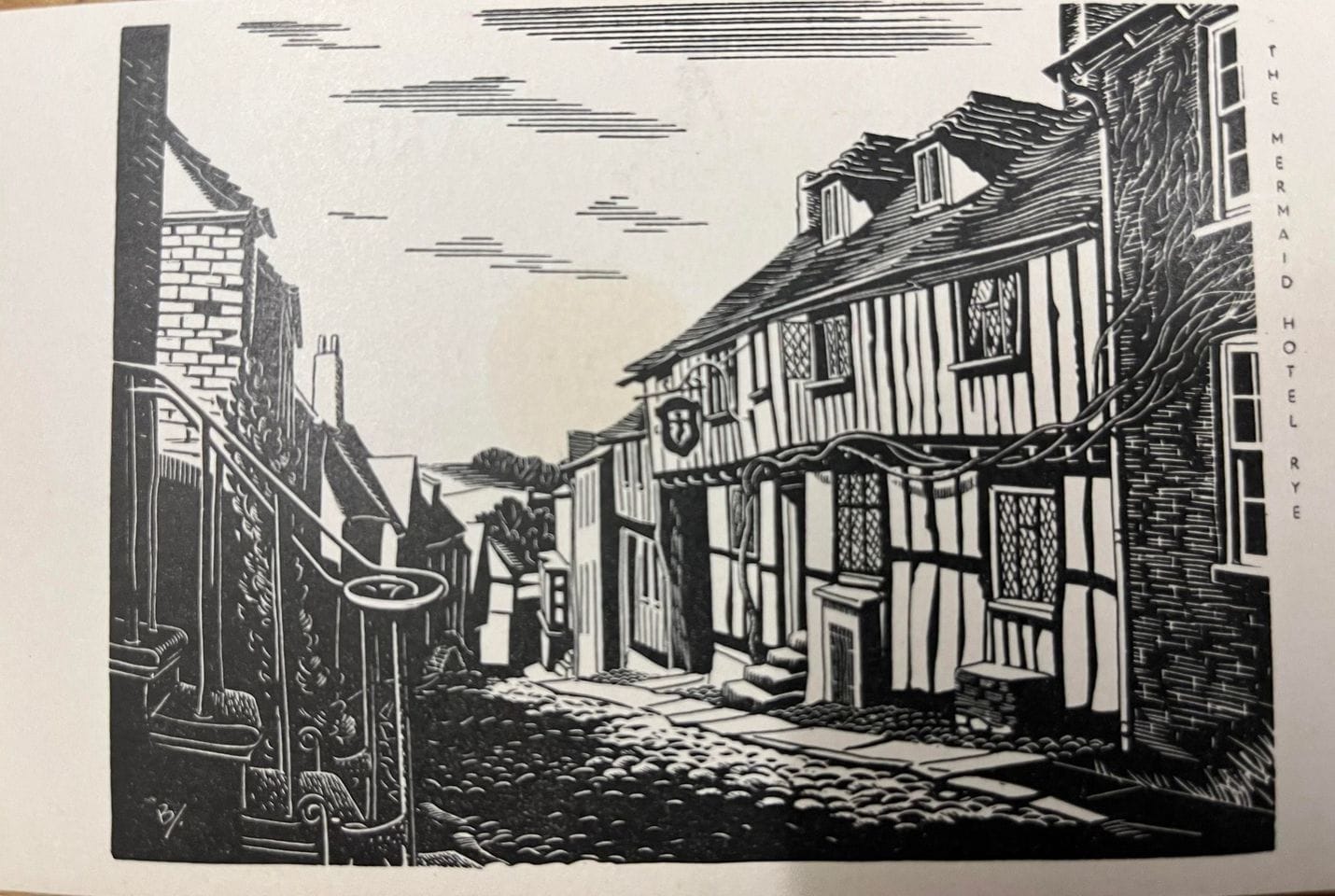
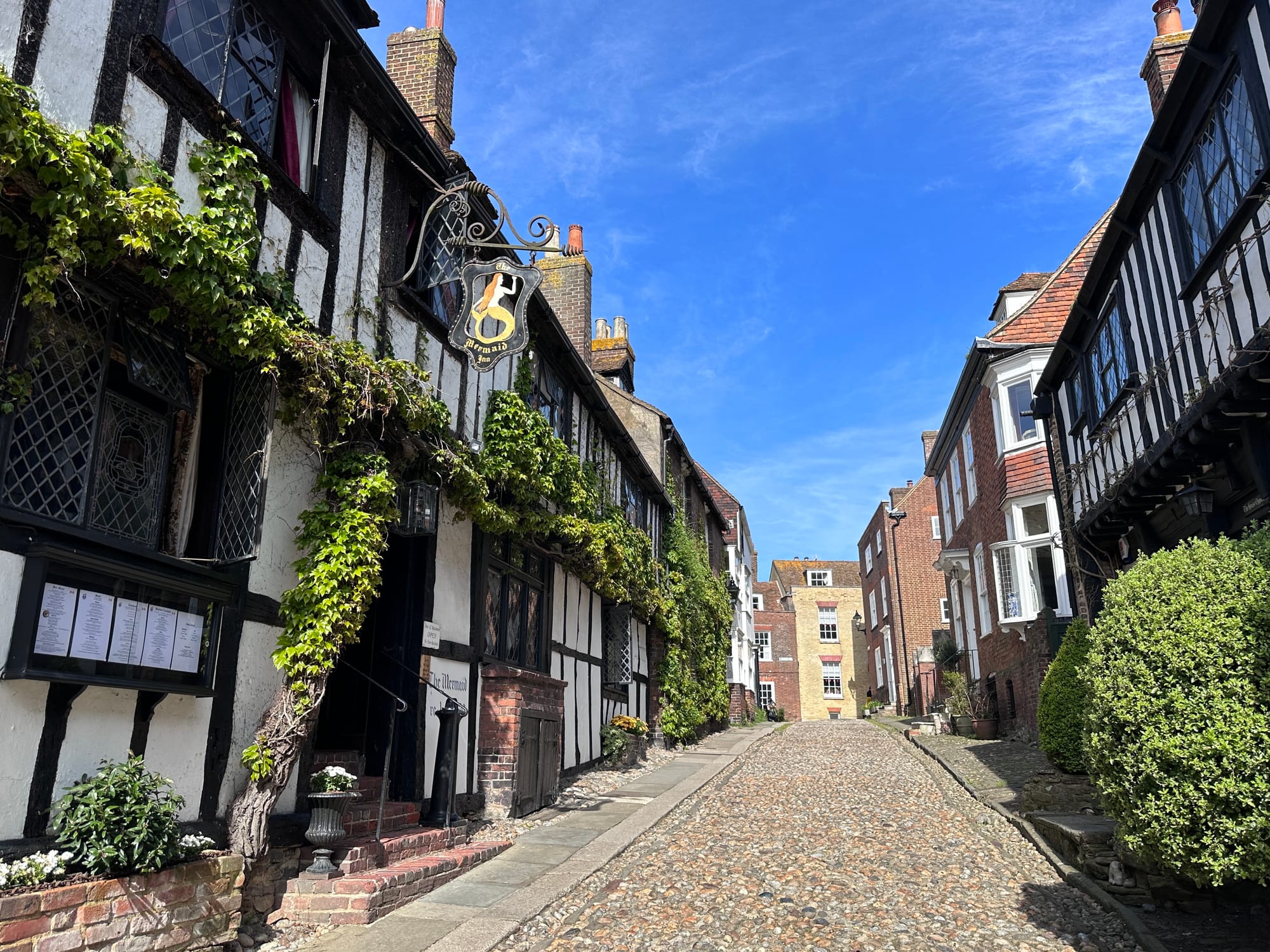
It’s been called the prettiest street in England, and particularly on a sunny day it’s easy to see why. Mermaid Street has everything needed to make it picture perfect. Cobbles, on a hill steep enough to be picturesque, but not long enough or steep enough to exhaust the visitor. Half-timbered houses, mellow Georgian brick houses, an ancient inn and an abundance of flowers. Add to the mix wonderful house names like The House with Two Front Doors or The House with The Seat, and it is an ideal postcard view or romantic film set.
Central to the street is the Mermaid Inn, originally built in 1156. Now it gives its name to the street, but it was originally called Middle Street because, believe it or not, it was in the middle of the town. It kept this name until the beginning of the 19th century, when it became known as Strand Hill, ending, as it does, by The Strand. It was given its more romantic, tourist-worthy name some time in the middle of the 19th century.
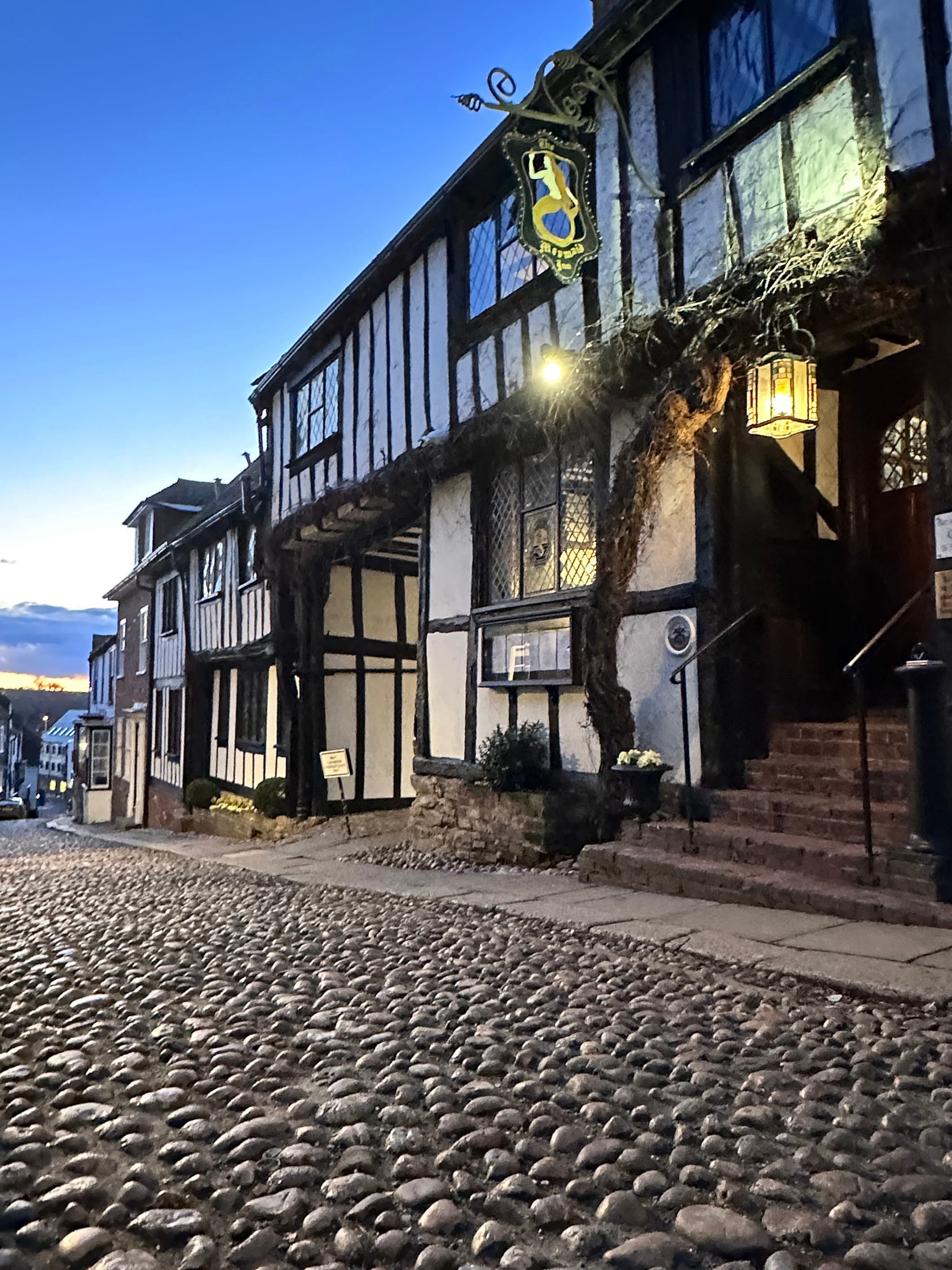
The Mermaid Inn, along with nearly the whole of Rye, was burnt during the infamous French raid on June 22 1377. All that survived of the original building was the cellars, which were incorporated when it was rebuilt in 1420. On August 27 1597, we know that William Shakespeare was paid 20 shillings for a performance at the Mermaid, by the Chamberlain’s Men. The day after, John Fowtrell, the landlord, was elected mayor of Rye. He was landlord because his wife, Cicely Didsbury, was the widow of William Didsbury, the previous owner. He had left it to her in his will.
By about 1770 the inn was a private house, owned by Charles Poile. The surname is well known in Sussex. There is also a very talented young French cellist called Charles Poile. The name means bristle in French, so the family may originally have been brush makers.
Hartshorn House is a fine half-timbered building, built in the 15th and 16th centuries. It was used as a hospital during the Napoleonic Wars, hence its other name, The Old Hospital. During the 1960s it was home to the novelist Rumer Godden. It was, when built, a typical merchant’s house, although there seems to have been a house on the site since about the 12th century. It had been the home of Samuel Jeake II, brought into his family as part of his wife Elizabeth’s dowry on their marriage in 1670.
Now one of the best streets in Rye, in the past this was far from so. We know from the census of 1891 that it was one of the poorer parts of town, with quite an unenviable reputation. This hadn’t changed right up until the middle of the 20th century, when rat infestation was, sadly not uncommon.
As well as teeming with rats it was teeming with children, apparently 70 of them, 54 still of school age. Indeed, very conveniently, there was what was called a Board School actually in the street. These were schools taken over by the government in 1870, when the Education Act was passed into law. In 1891 school education had just become free. Attention was paid to cleanliness, morals and handwriting, and good discipline was strictly maintained. They were called Board Schools because they were run by a locally elected board and paid for out of the rates. The leaving age was 12, raised to 14 in 1918.
The school had been built in 1867 and called Mermaid Street National School. By 1891, instead of taking both sexes, the boys were taught in Mermaid Street with girls and little children at another school around the corner in Lion Street.
In 1891, the census tells us that 199 people lived in the street, in a total of 42 households, whilst a further eight houses in Mermaid Yard were home to 31 people. Most of the men were what was then called general labourers, so doing whatever work they could find. More skilled occupants included a baker, a shoemaker and a miller. Most of the women gave their occupation as needlewoman or laundress.
At number one, now named The First House, was one of the better-off inhabitants, Henry Pepper, with his wife and little son. They employed two servants, paid for by Henry’s work as a wine and spirit merchant. Sadly, before the century closed, both Mr and Mrs Pepper had died. Number one was originally part of the holdings of Lamb House. First rented out during the1840s, in 1883 it was auctioned off with many other properties originally owned by the Lamb family, including Lamb House itself.
Mermaid Street now is one of the most visited parts of Rye. Tourists take their selfies (often obstructing others) and so its beauty is known all around the world.