


A suspected yellow-legged hornets' nest in Udimore was destroyed on Tuesday, July 22 having been found in an outhouse in the village a week before. Investigations are continuing to confirm whether the insects are hornets, also known as Asian hornets, which are regarded as one of the UK's biggest threats to bees.
Hornets are just one danger faced by bumblebees, highly important as pollinators and playing a vital role in the agricultural and natural eco-system, as well as the economy. The insect population is declining around the world, but bumblebees face a unique threat that makes them particularly vulnerable.
"Without bumblebees nature would be quieter and lack many foods we love. It may become a crisis," says the Bumblebee Conservation Trust.
There has been a particular decline in Britain over the past century. Two species became extinct and eight (around a third) of our remaining twenty four species are currently listed as conservation priority due to their scarce distribution. The rarest bumblebee, the great yellow, is now only found in the far north and west of Scotland.
The UK has lost 97% of wild flowers in the last century which means bumblebees are struggling to find enough food and nesting spots to survive.
Building much needed housing is also an issue, as it cuts habitats off from each other and reduces green spaces and countryside. Insecticides can directly kill and too many honeybees and commercially reared bees have increased competition for food and can lead to the spread of diseases.
There are an estimated 65,000 colonies imported into the UK each year to support the soft fruit industry although some of the trade is marketed at gardeners. In 2015 Natural England tightened the regulations to prevent the use of non-native sub-species which had been permitted to be purchased by licence holders in the UK. 2024 was the worst year for bumblebees since records started to be collected says the Bumblebee Conservation Trust.
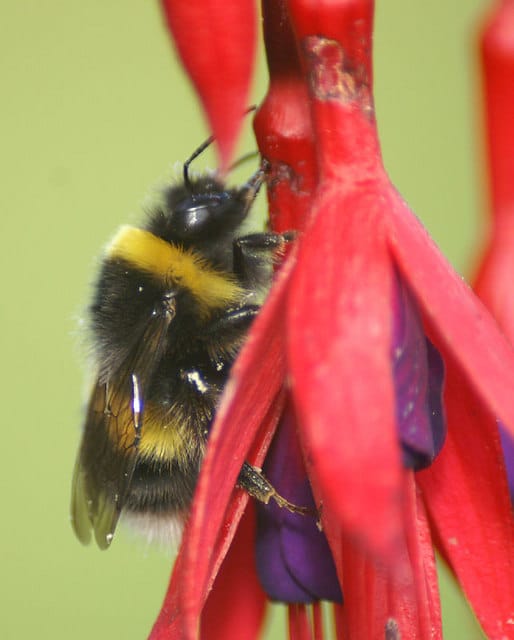
Bumblebee facts
- Bumblebee's wings beat 130 or more times per second.
- In the winter colonies die out completely except for the queen bumblebee who goes into hibernation to establish a new colony the next spring.
- A queen bee's sting is less harmful as the stinger is smooth and does not get embedded in the skin. They rarely sting a human but rather another queen bee.
- The male bumblebee does not sting as they don't have the stinging anatomy. Their role is to reproduce with a fertile queen
You can help bumblebees (or any bees) by doing small things like putting insect-friendly plants in the garden. Lavender, rosemary, daffodils and tulips would be helpful. Or keep a garden section a bit wild to encourage bumblebees to build their nests.


