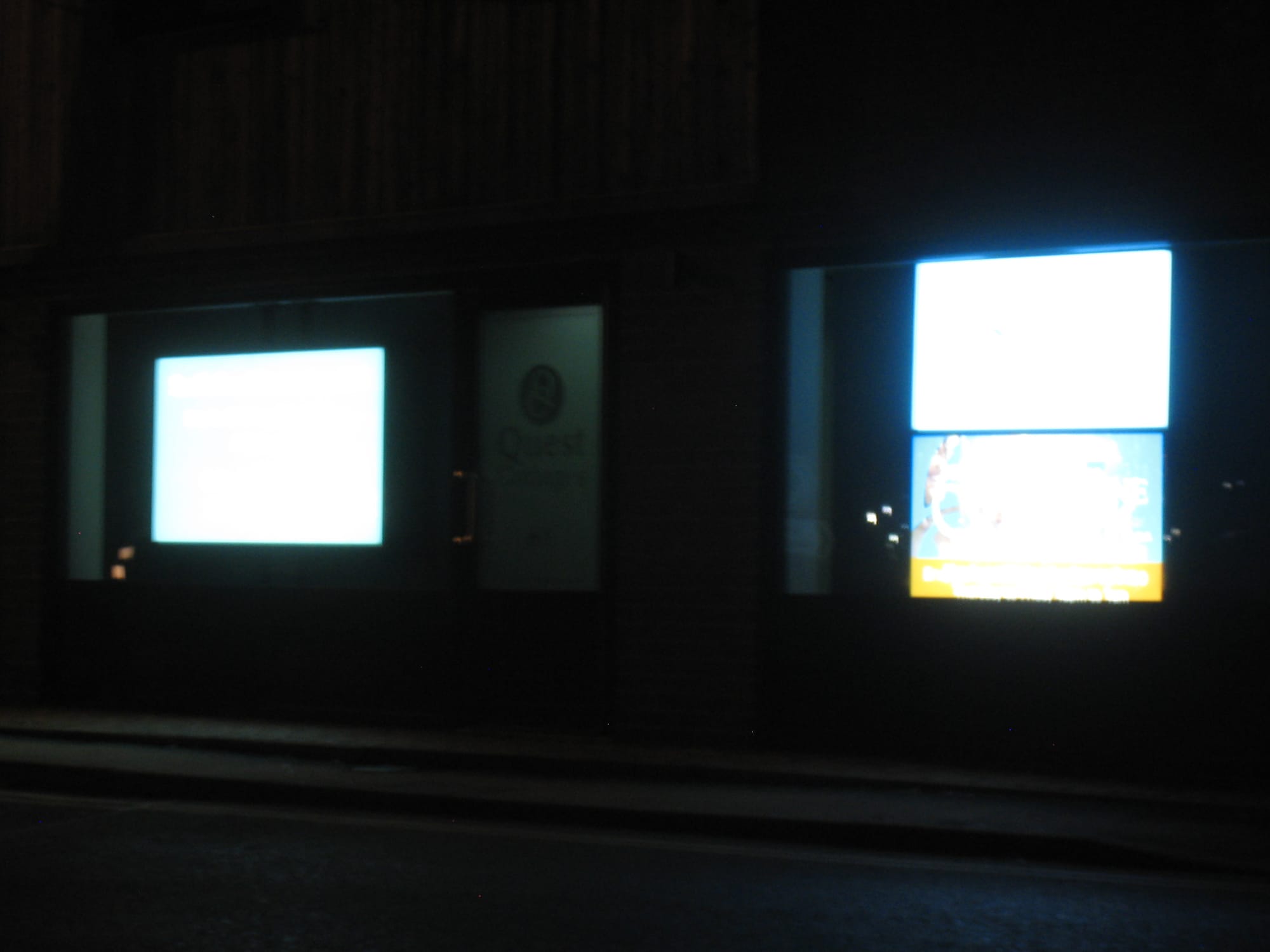
Rye residents and visitors cannot fail to have noticed the three large advertising monitors in the window of a newly installed business at the A259, Fishmarket Road roundabout.
A question many people are asking is whether these bright screens are allowed in Rye and if planning permission has been given for them. If not, why is Rother District Council allowing the screens to remain? Where, if anywhere, does Rye Town Council stand on this challenge to the town's historic identity?
In the first instance, one should point out that if permission has indeed been given, or "deemed consent" applies, any complaint about the screens appears rather futile. One might wish good luck to the company concerned. However, if consent has been granted, the planning precedent will mean that every storefront, office and business premises in Rye will be able to display large advertising video monitors in their windows. For a historic town such as ours, this would surely represent the death knell for its vital tourism offering. Rye would soon look more like a miniature Las Vegas.
Astonishingly, for several months the roundabout colour screens have been operating 24 hours a day, seven days a week in a largely uncommercial area of low footfall. The only real targets for this advertising are vehicles using the roundabout itself, with drivers at risk of being distracted by the screens. At night, the glowing monitors are especially out-of-keeping with Rye's historic character. It's unclear what view East Sussex County Council's roads and transport division has on these screens — if indeed they know anything about them.
Several years ago, when BP proposed, unsuccessfully, building a service station at the top of Udimore Road, the local community's arguments against intrusive illumination and the impact on the character and appearance of the area carried great weight.
A thriving business community is the lifeblood of small towns, but some people would argue that councils — both district and town — often have a blind spot when it comes to enforcing regulations on businesses — even when the law is crystal clear, as it seems to be in this case. Appearances can be deceptive, however: it could be that huge video screens are entirely permitted within the town boundary.
Nevertheless, with regard to the roundabout screens, there are strict rules relating to illuminated advertisements in the Town and Country Planning (Control of Advertisements) (England) Regulations 2007. Adverts displayed inside a building may not be illuminated and must not include any intermittent light source, moving feature or animation. No advertisement can endanger road users, or impair the "visual amenity" of the site. Moreover, the premises in question are reportedly located within the Rye Conservation Area, where illuminated screen advertisements are not permitted.
Another example of advertising that negatively affects Rye's identity as a visitor attraction relates to the two large, permanent wheeled hoardings at the side of the A259 just outside the Rye town boundary. Visitors (and locals) approaching Rye from the east and expecting to view the ancient town rising majestically on its hill have long been sorely disappointed when their first visual experience of Rye are these intrusive advertising signs.
Given that a huge proportion of advertising has moved online, it's highly unlikely that such digital screen adverts or large hoardings sell much in any case. All they do is adversely affect the town's character and give a disappointing impression of Rye's priorities.
Rather than permitting local residents to lodge informal complaints about potential planning violations, Rother District Council obliges complainants to make a detailed, formal complaint online, which deters residents from complaining. The end-result is anti-democratic, as it restricts public participation in the decision-making process. The length of time it takes to receive a response from the council leads to a tremendous amount of uncertainty over what advertising is allowed and what isn't.
RDC does have a duty to exercise powers under the Town and Country Planning regulations "in the interests of amenity and public safety".
Much has been said recently about the need for councils to communicate better with residents in Rye. One thing Rother District Council could do to help its residents would be to identify unapproved advertising and clamp down on it as quickly as possible — before it gets out of control. Where uncertainty exists, the regulations should be communicated to residents so that they know the position.
If anyone from RDC, or elsewhere, can assure Rye people that illuminated screen advertising on a busy roundabout in fact has 'deemed consent' or planning permission, I'm sure every business in the town would be grateful to hear from them.