It was forty years ago this week - April 14 1985 to be precise - that Channel 4 first broadcast Mapp and Lucia. Filmed in and around Rye, the TV drama is still regarded as the best screen interpretation of EF Benson's very Rye characters. Two series were broadcast in 1985 and 1986 and they're currently being shown on Rewind TV (Freeview 92, Sky TV 182, Freely 150 https://rewindtv.uk/)
Kim Rye has very fond memories of the the filming - and luckily for us she also had her camera to hand.
It seems like a lifetime ago since during one of my strolls around the sunlit streets of Rye, on a short break in the far-off halcyon days of the mid-1980s, I suddenly found myself in an apparent time warp as I rounded the corner of Church Square and Watchbell Street.
I immediately recognised TV’s former Miss Jean Brodie Geraldine McEwan’s signature red hair, fashioned into the sleek bob of her character Emmeline (Lucia) Lucas; then Prunella Scales, who had previously been known to me as Sybil, the shrill wife of the bombastic Basil Fawlty of Fawlty Towers fame. Then I caught a glimpse of Yes Minister’s Nigel Hawthorne, resplendent as the foppish Georgie Pillson.
I stood, in the baking sun, transfixed by the busy scene of film crew setting up, a wardrobe assistant adjusting hats; and yes, there was Miss Mapp – Prunella Scales’ slight figure magically assuming the stouter shape of her latest character. I took in the nearby vintage cars, gleaming in the sunshine and a gaggle of onlookers admiring their sleek lines.
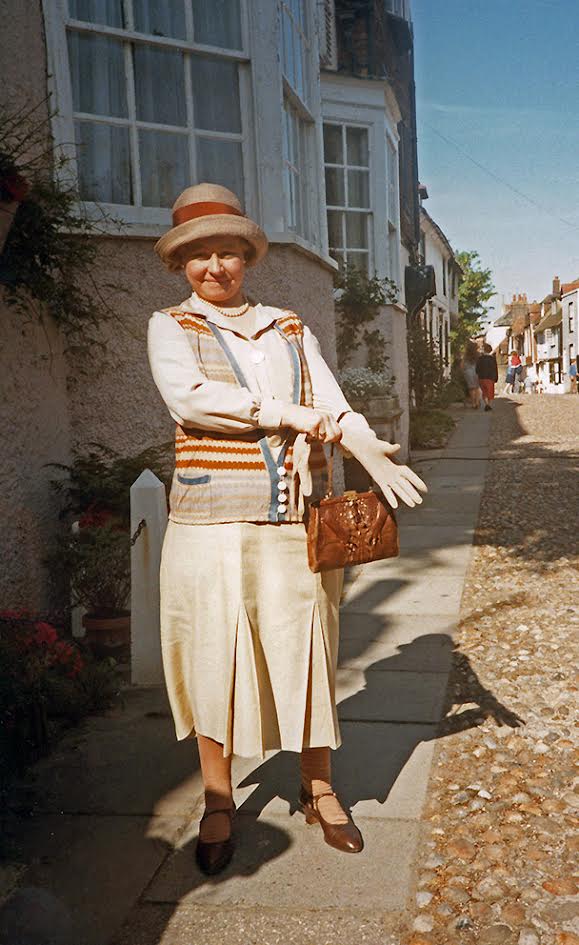
Then suddenly came the shouts of the director to the cast, “Positions please” as a growing crowd, including myself, were swiftly ushered to the opposite side of the street, and ordered to keep our backs to the walls of the houses. “Quiet please!”, came the call.
I held my breath as the actors took up their positions. Nearby was the wonderfully effete figure of Nigel Hawthorne, gloves in hand, already in character, the perfect embodiment of Georgie Pillson. I was agog, rapt with concentration, as the cameras started to roll and the dialogue began. I could hear the imperious tone of Lucia and marvelled at the precision with which she delivered her lines.

As the cameras first rolled you could have heard a pin drop. We had to be careful not to stand too close to the action, as we might be seen reflected in the windows of the houses opposite. I remember one fellow in the watching crowd accidentally jangled some change in his trouser pocket and the director yelled "Cut!". The man looked a little embarrassed. After that, I hardly dared to breathe! Neither did he! I remained transfixed and rooted to the hot cobblestones – fascinated as the scene unfolded and magically rolled back 50 years to the elegance of 1930s Rye.
The first scene was Nigel Hawthorne’s dapper Georgie Pillson and Geraldine McEwan’s beautifully elegant Lucia stepping out of Diva’s tearoom, after a rubber of bridge (“Worship” episode), whereupon a police officer politely disrupts the game, requesting the mayor’s (Lucia’s) signature on an urgent summons.

Throughout the hot afternoon there were more breaks in filming and I got a chance to speak to the crew. One of them told me that Prunella Scales was wearing body padding (I had thought she looked much bigger than I remembered her in Fawlty Towers) and her cheeks were lightly padded by the makeup department. This was because Prunella is actually very tiny. I was also told that she had a clever way of baring her teeth when acting the part, in keeping with Benson’s garrulous Miss Mapp.
Apparently, Prunella also had a special way of standing and puffing herself out to look even more rounded, emulating the stout character of Miss Mapp in the books. The crew member said both actresses had gone to great lengths to perfect their characterisations and later, when I read the books and watched the series, I could see exactly what he meant; their characterisations, I later reflected, were flawless.
During a short break in filming, I managed to speak briefly to Nigel Hawthorne, Geraldine McEwan, and Prunella Scales and get their autographs – and took some photos – which they obligingly posed for. They were not “selfies” as we know them today – no smartphones back then! All three actors were thoroughly gracious and polite, albeit brief, as other onlookers were also waiting for snaps and signatures.

“Pru”, “Nigel”, and “Gerry”, as the crew called them, seemed to remain in character even during their breaks. They were very professional and acutely absorbing and interesting to watch, and when the series later aired on TV I was glued to the screen, excitedly noting the scenes whose creation I had witnessed. Nigel Hawthorne’s Georgie Pillson was beautifully observed, down to the gimlet eyes, the dandyish mannerisms and even the subtly mincing gait of Benson’s creation.
Later that evening, tipped off by a crew member, I returned to Rye and witnessed the night filming of the last scene of the final episode, where Elizabeth and Benjy leave “Mallards House” (Swan House Cottage) after the embarrassing encounter with the Duchess of Sheffield (the wonderful Irene Handl who was not present unfortunately).
Suddenly, Watchbell Street was illuminated by the brilliance of arc lights.

During the course of night filming, the director became increasingly frustrated with
re-takes and – just as they perfected the desired scene with Major Benjy (Dennis Lill, who had not been present at the daytime shoot) and Mrs Mapp-Flint (Prunella Scales) standing in the archway of “Mallards House”, a blackbird suddenly burst into full song – mistaking the arc lights for sunrise. Red-faced, the director yelled "Cut" for the umpteenth time, in a moment hilariously reminiscent of the director in the 1952 film Singin' In The Rain during the duelling cavalier scene. A much smaller crowd this time, we tried, unsuccessfully to suppress our laughter.
I also recall a crew member chalking on the pavement edge underneath the archway of the house, these chalk marks were to indicate where Major Benjy and Mrs Mapp-Flint should stand briefly before they marched off up the street, after the hasty departure from the doomed dinner party attended by the Duchess of Sheffield. This take, I later discovered, was the very last in the series (“Au Reservoir” episode).
Another clip filmed that night was where Lucia returns from her abortive trip to Sheffield Castle to see the duchess. As Lucia’s chauffeur-driven car pulls up outside “Mallards”, she can hear Olga Braceley (Anna Quayle) singing an aria inside the house – of course, the sound was added later, as this segment was filmed in the studio.

Then, as if by magic, the scene quickly disappeared as the crew hastily packed away
their equipment and my time travel adventure ended as silence once again descended over the lamplit cobbled street – and as this was Rye, I remained by the church wall for a few more minutes, still absorbed in the 1930s.
I can never walk down Watchbell Street without revisiting that magical day in my head. It is one of my most abiding memories of the literary enigma that is Rye. This day has since then assumed a dreamlike quality in my head, almost as if it never happened. However, I have the pictures to prove that it did.
I hope you enjoy looking at them!
Thanks to Kim for the story and photos. Rye News will have more next week when we look at some of the locations used in making 'Mapp and Lucia' in Rye in the 1980s.