Rye residents may be familiar with Mason's Field – a large open space alongside Udimore Road. How many of those same residents have ever wondered whether there was any story behind the name? I must admit that I hadn't until a remark from Liz Butt, a music therapist, who founded the locally based Music Well charity. Liz said that Mason's Field had been given to the people of Rye by a Mr Mason and that moreover he was her great-grandfather.
I was intrigued and felt that I wanted to know more. I read what I could on the subject which didn't take long – there is very little available. However, I was able to get valuable information from Mrs Lindsay, Liz's mother, who patiently supplied answers to some of my numerous questions.
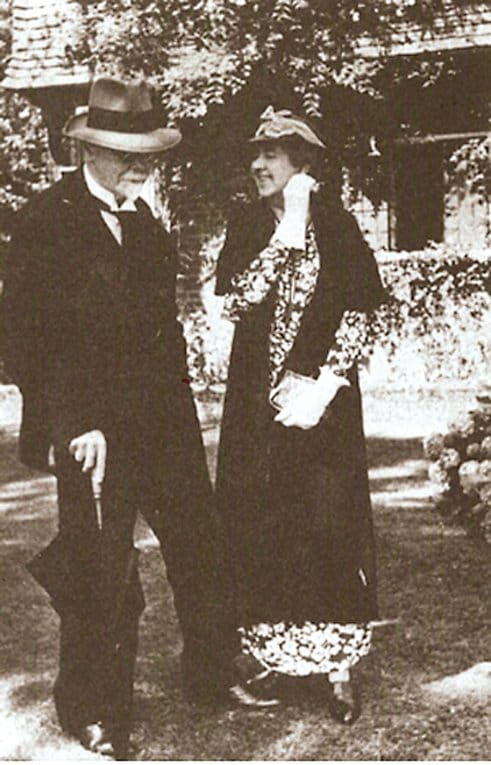
I learnt that Mrs Lindsay's grandfather, Thomas Alexander Mason, was born in 1859 in Southwark. He was brought up in comfortable circumstances, subsequently inheriting a successful family tobacco business. What made Thomas different to many another well-to-do businessman was that he devoted large sums of money to the public good, becoming a private benefactor on an impressive scale, but now little recognised because he was as modest as he was generous.
Mr Mason's form of philanthropy was to buy pieces of open land which he then donated to the local community to be used for recreational purposes, but without his name being known. Mrs Lindsay shared an interesting family story of how one donation came about. She said that her grandfather, an enthusiast for the internal combustion engine, was motoring through High Halden near Tenterden one fine day when his chauffeur narrowly avoided a collision with a little girl playing in the road. This encounter led to the decision to buy some land for her and other children to play in safety well away from the road. The family treasures cuttings from two Sunday newspapers The People and the Sunday Graphic for September 23, 1934 which give a very brief description of this incident. It was unusual enough – with emphasis on the anonymity – to merit mention in the press.
The fields that Thomas Mason gave are in many locations including Hastings, Ninfield, Iden, Westfield, Beckley and Icklesham as well as the ones already mentioned and many more besides. But apart from this area there are sites further afield in Dorking, Glastonbury and Runnymede; most are in the south of England though there was a donation of land in Dent in Yorkshire given as the site of a new vicarage. Sometimes Thomas would take a day away from work, catch a train and get off at a random location. If on his wanderings he found a promising spot, he'd arrange to buy it and donate it.
Thomas's wife shared her husband's ethos. When an important wedding anniversary was looming Thomas offered his wife a diamond brooch to mark the event. His wife declined, saying that instead the money should be spent on a holiday home for poor children – hence the establishment of Pin Cottage, Reigate, offering fresh air and open space for children from the smoky and overcrowded East End of London. Mrs Mason was a talented amateur musician who delighted in holding musical evenings as well as being a poet of merit being published in Country Life among other popular periodicals of the era.
One plot of land was in Lowfield Heath. In 1926, when the land was donated, Lowfield Heath was a charming rural spot but subsequent decades saw the demolition of the village due to the expansion of Gatwick airport. The family agreed to sell the land, which had become rather valuable, and the money raised was used to establish the T Mason Trust.
The Tilling Green estate is reached via Mason Road. The council needed permission to put a road through the open space that Thomas had given to the people of Rye in order to access the land behind it. Eric Mason, Thomas's son, agreed to this hence the name is preserved in Rye. Eric, following in his father's footsteps, subsequently gave the playing field to the people of Iden, still well used and appreciated today.
Thomas Mason lived in Reigate for much of his life but in later years he and his wife moved to Wittersham and this is where he died in 1949. In the family's possession is the parish magazine for St Paul's Church for Seamen in Stepney for Easter 1958 reporting Mrs. Mason's death in February. There were tributes from many who'd known and benefited from the generosity of Mr and Mrs Mason over more than 40 years. Some of those who'd travelled from Cannon Street to Reigate, excitedly clutching brown paper parcels of their worn and patched spare clothes, told how they'd experienced clean, comfortable, orderly Pin Cottage with plenty of good food, books to read and a huge toy chest before being sent home after two weeks with better clothing than they'd arrived with. Mrs Mason had been President of the Nursery at St Paul's – a pioneering establishment, one of the first in the country to offer safe childcare for mothers forced to "work or starve" as the magazine put it.
Thomas Alexander Mason was a modest and retiring man who did his charitable work privately and anonymously, thus little is known about him, but his valuable legacy lives on and continues to benefit numerous communites, as he intended. Despite his reluctance to be named and lauded I hope that others would agree that he deserves lasting gratitude and to have his name and legacy remembered.
Mr Mason's great-granddaughter, Liz Butt, is also enabling children to play by providing music therapy in Rye, thus continuing the tradition of philanthropy.
Photos: courtesy of the Mason family
Photos: courtesy of the Mason family