


Annually, the Friends of St Mary's Rye make a mid-summer visit to two or three local churches and then take tea with a Women's Institute. This year Chairman Anthony Kimber opted to consider churches on the edge of the Rother Valley and take tea at Stone. On June 28, with the temperature rising towards 30C, some 35 Friends joined two Rye Community buses for the outward journey.
Surrounded by one of the largest crowds arriving at Rye station for onward movement to Camber, we headed for St Peter's at Newenden. The visit there coincided with a Flower Festival.
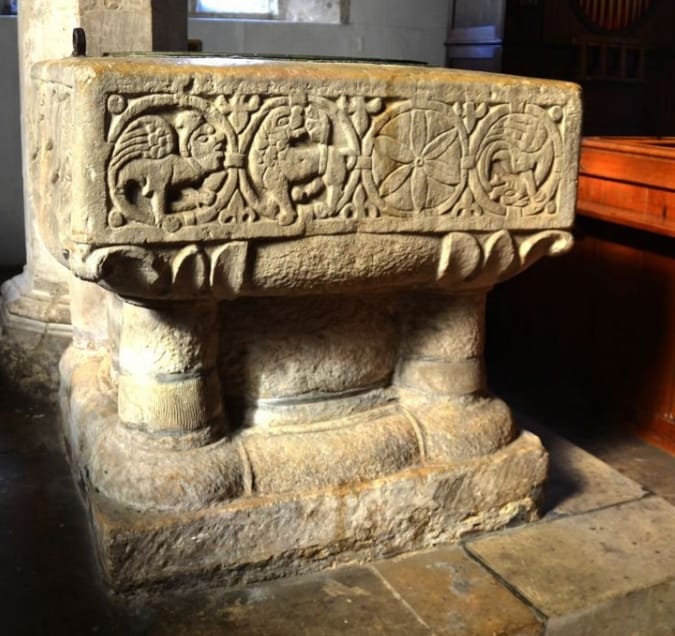
Dating mostly from the 14th century, the church holds a gem: a superb font, carved with intricate designs of intriguing late Saxon or early Norman motifs. Of particular interest to the Rye Friends, this font provided the model for a 19th-century copy in St Mary's, Rye. The church used to be much larger, but the chancel collapsed in the 18th century and the west tower was pulled down shortly after. The village had to wait until 1931 for some rebuilding.
After extraction from Newenden it was off to St Nicholas at Sandhurst. The Black Death of 1348 resulted in the relocation of dwellings away from the church to the Roman road from Hastings to Rochester. Much of the present church building is of the 14th century but the Victorians made many “improvements”.
The church is full of details indicating its history, including a blocked south doorway with redundant holy water stoup. A stairway is evident, which before the Reformation provided access to the Rood loft. At the top of the south window in the south aisle there are fragments of 15th-century glass and an adjacent window with glass dating from c1450.
In 1705, Titus Oates (Catholic plot against Charles II) was curate here. Finally we noted the superb 20th-century wooden (Welsh carved) reredos behind the altar, depicting the Last Supper.
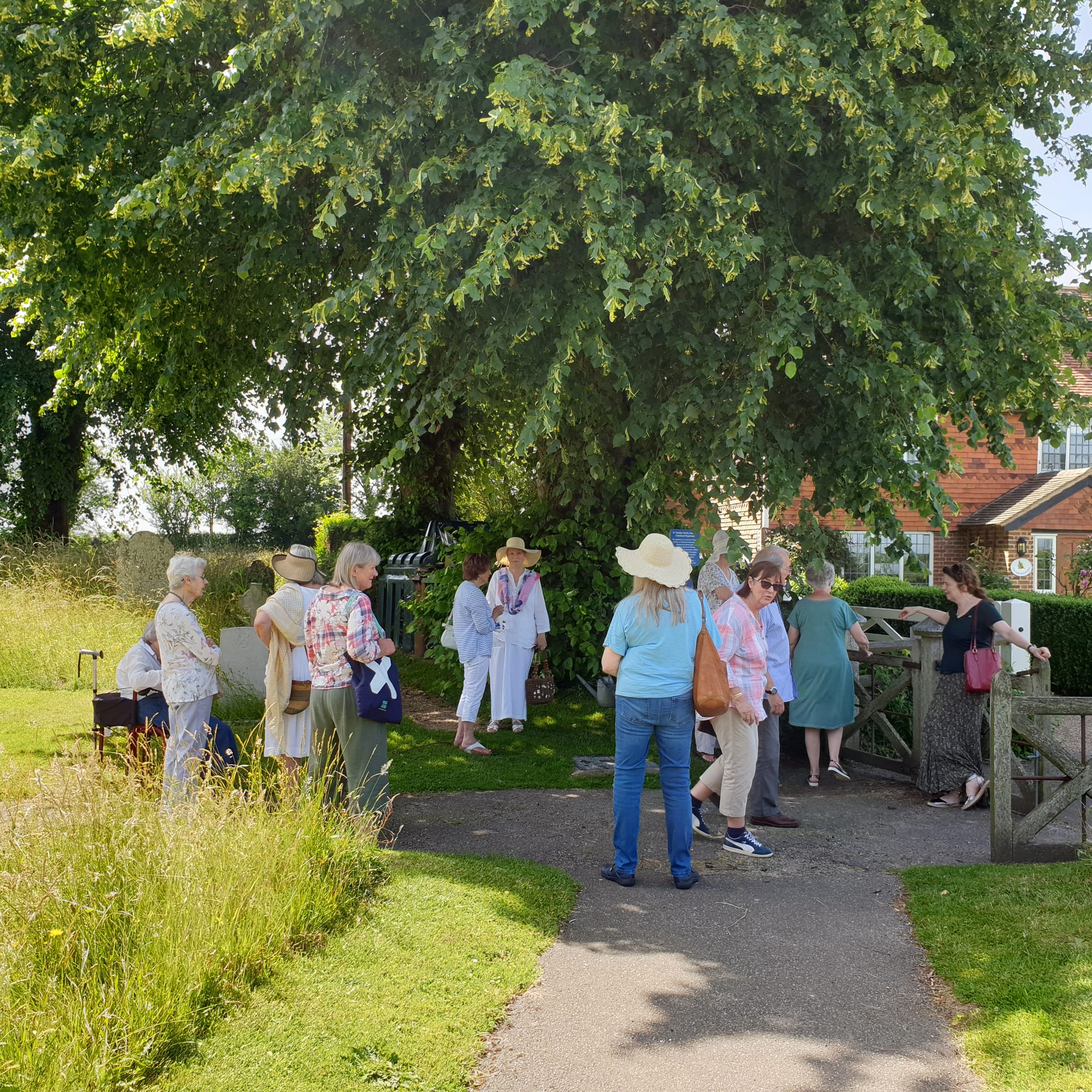
After Sandhurst it was away to the Saxon settlement of Rolvenden and its church, St Mary the Virgin. This sits on a mound on the southern end of the village. There was a church here recorded in the Domesday Book (de Ruluindamme), but the present one dates from around 1210. Built originally by monks from Canterbury, today much of the church is 14th and 15th century.
Some interesting features include the stairs to the Rood Loft removed in the 16th century; marks around the south door from the sharpening of tools, knives and swords; some 17-18th-century texts painted onto the wall and a 14th-century hexagonal font emblazoned with the arms of Guldeforde and Culpepper.
There is a plaque commemorating the burning in Canterbury in 1555 of vicar John Frankesh a martyr, who refused to subscribe to the Catholic faith of Mary I. Of great interest was the raised squire’s pew over the South Chapel.
Several wealthy and influential families lived about the village, the Guldefordes at Halden; the Gybbons and the Monypennys at Hole Park, and the Berhams/Barhams at Maytham Hall. Each had adopted the south chapel as their own. In the early 19th century a gallery pew (Squires Pew) had been installed to form a raised “drawing room” or “dining room” above the chapel. This allowed some separation from the village flock!
Outside in the graveyard the Friends were invited to find the stone marking the grave of Barbara Moon or Williams. Born in 1811 from a relationship between a soldier and a camp follower in the Peninsular Campaign, she had later been carried across the field of Waterloo in a wagon by those searching the post-battle field for casualties. She had lived to the early 1900s and died in Rolvenden.
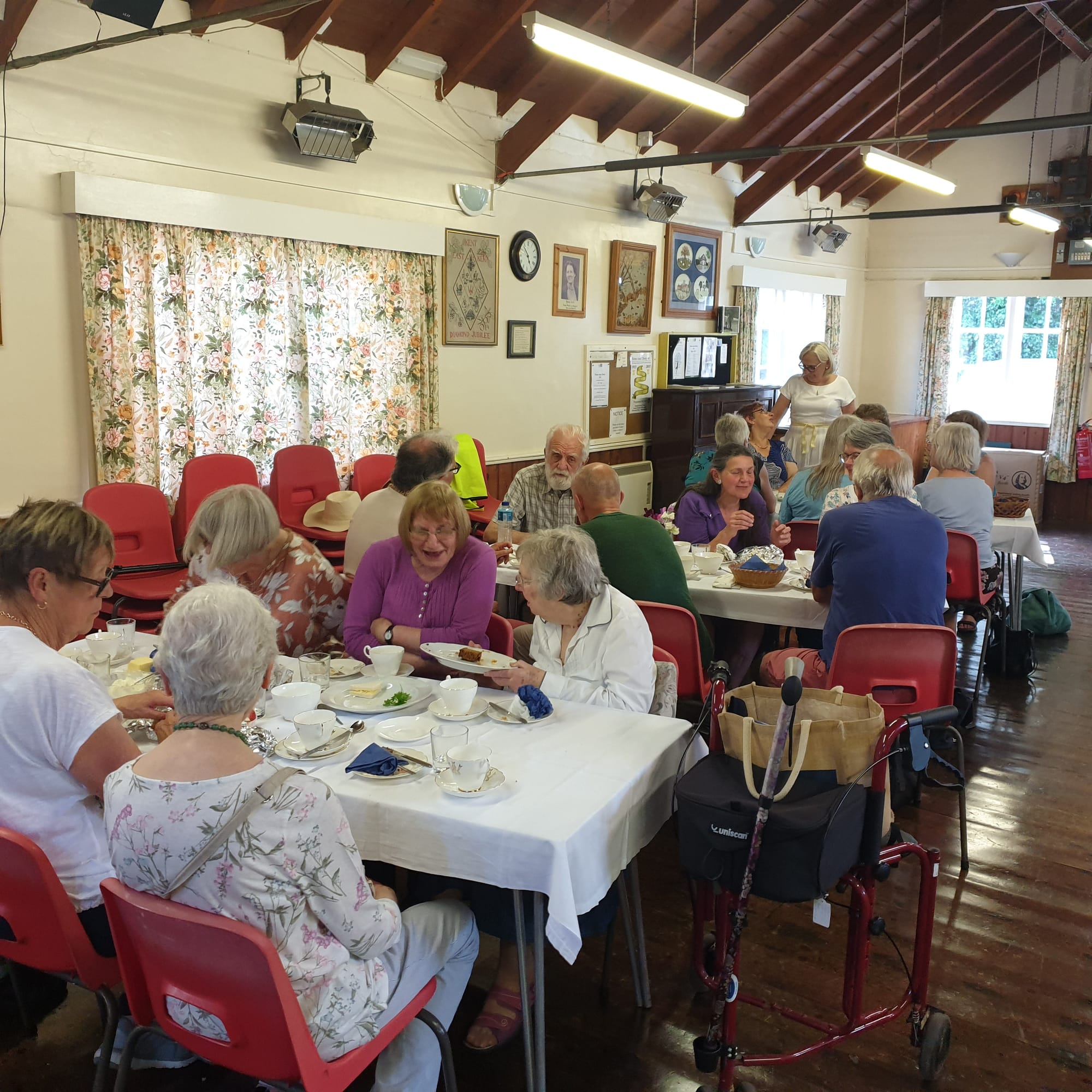
After Rolvenden it was time for tea. A very pleasant drive in the afternoon sunshine saw us arrive at the Memorial Hall of Stone cum Ebony. Here we were greeted by the local Women's Institute (WI) with tables laden with a typically English tea. After thanks to Rye Community Transport, Paddy and Gill Harvey for coordination and the WI for tea, the group headed back to Rye.


