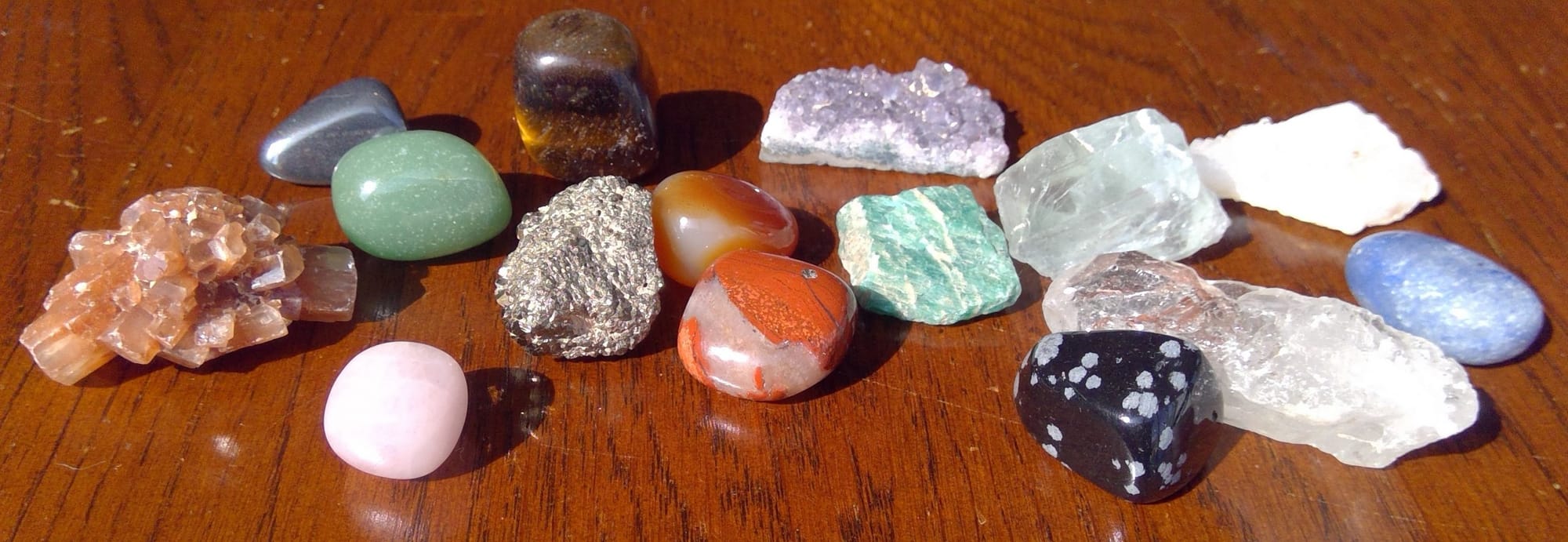
Here is the latest submission from Xavier Marrs, one of two new contributors to Rye News under the age of 16. We welcome contributions from the younger generations and look forward to receiving more over the months ahead.
Many of you would have heard about fossils, such as the remains of dinosaurs from millions of years back.
You also may have heard of crystals, spiky things you find in caves.
But you may not have heard of geodes.
In this article, I am going to tell you about all of these wonderful things.
Fossils
Fossils are any preserved remains, impressions, or traces of a once living organism from a previous age.
An Argentinosaurus dinosaur, which was found in Argentina, was about 34 metres in length. And if you do not know how long that is...it is very long.
You would never imagine this, but sea creature fossils have even been found on the top of Mount Everest. And Mount Everest is 8,849 metres above sea level, in other words, really quite tall.
A team has extracted what could be DNA molecules from a 125-million-year-old fossil dinosaur (by the way, that’s really old).
So, if you happen to be walking along, and you notice an unusual marking, take a closer look! It could be a fossil. There are a number of Iguanodon footprints at Pett Level.
Geodes
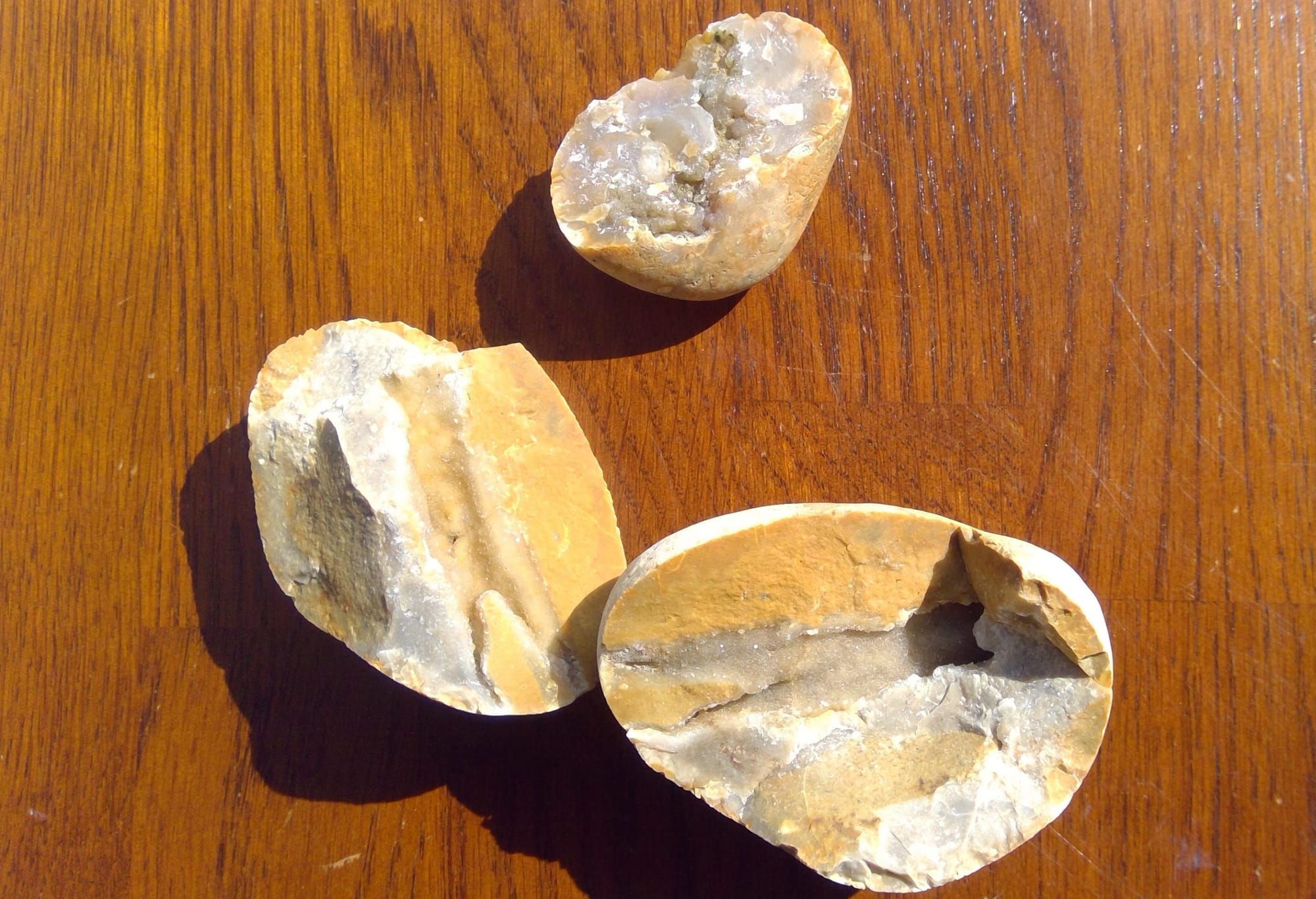
A geode is a hollow rock lined with an inside layer of sparkling crystals.
Geodes come in many varieties. Some are a band of crystals through the middle of a stone, others are holes lined with crystals.
Although the geode is embedded in rocks that are about 250 million years old, the crystals themselves are much younger than that. Radioactive dating shows that they formed between 2 million and 5.6 million years ago.
They are formed when water residues create a thin layer of minerals inside the cavity. As water flows through the geode, additional mineral layers are deposited. Over thousands of years, these layers of minerals build crystals that eventually fill the cavity.
It takes thousands of years for a geode to develop. The longer the geode has to develop, the bigger the crystals can get. Some in my collection would have taken millions of years to form.
Crystals
I find crystals amazing because they evolve in a wide variety of shapes and colours.
One of the most special things about crystals is their shape. Their mineral, cellular structure is what gives crystals their unique appearance.
There are also many, many types of crystals. They can grow from ceilings, from the ground (such as in the Naica Mine in Mexico) as well as simply inside rocks (geodes) and in a range of other places.
There are always many interesting things to find on the beach, whether it be fossils at Pett Level, crystals in caves at Hastings or geodes that cover the beach at Rye Harbour and Winchelsea… I am often there cracking pebbles that I think will be geodes – that is how my collection, and interest, have grown.