


Members of Rother Environmental Group (REG) recently dialled into a worrying presentation on the government’s proposed "revolution" to the planning system and the knock-on damage to the local countryside.
The online presentation was given by Stephen Hardy, MBE, who is a trustee of REG and Sussex's Campaign to Protect Rural England (CPRE) and was also chair of the Robertsbridge Neighbourhood Plan committee. His presentation was entitled, "Changes to the Planning Law and Consequences", and gave an overview of the government’s proposed three tier zoning planning system and of the potential impacts on local democracy and the environment.
The current planning system, which has evolved over the past 70 years into a complex mix of processes supported by detailed land allocations and policies, is to be replaced by a simple three tier system of zoning. These zones would be classed as -
Growth: ‘land so designated will be given automatic consent for everything’ identified within a local plan;
Renewal: ‘where land will have a presumption in favour of the type of development identified by the local plan’, and
Protection: areas, such as conservation areas like the centre of Rye, where old style planning applications would still need to be submitted to the local authority, and in Rye's case that's Rother District Council.
Housing targets watered down
The government's proposals were published in August 2020 and Stephen stressed that it may take some time before it becomes legislation – and pointed out that one area, the dramatic increase in housing targets, has already been watered down (NB: under those plans 1,173 homes would have had to be built across Rother annually. That figure has since been revised down to 736 – which is still nearly three times more than is currently being built).
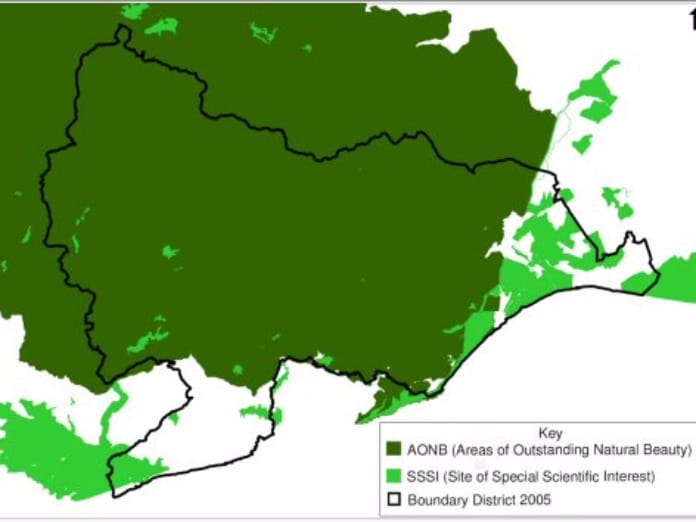
As recently covered in Rye News, the fact that 90% of Rother is in either an area of outstanding natural beauty (AONB) or a site of special scientific interest (SSSI) means that there is very little space in the district to build the increased number of houses that the government says needs to be built.
The new legislation is to help the government meet their housing target of building 300,000 houses in England each year. Stephen pointed out that historically this target had only ever been met following both world wars (in the 1930s and again in the 1950/60s) when local authorities massively increased their house building.
The ability for local authorities to build housing was curbed under the Thatcher government in the 1980s and Stephen noted that there is no reference at all to the need to build social housing within the new legislation.
Neighbourhood planners could lose control
Stephen raised particular concern for those towns without neighbourhood plans, though also stressed that it was far from clear how neighbourhood plans will be incorporated into the new planning system, if at all. He stressed that “they [neighbourhood planners] could lose the power to allocate sites as the community wants”. Under the new system, local authorities would be unable to refuse planning applications if the area had already been ‘zoned’ for ‘growth’ or ’renewal’.
One of the key concerns with the proposed legislation is that zoning is a very blunt instrument and will not take into consideration local issues or changing circumstances. It is expected that zoning would be reviewed every ten years but, if an area is zoned in the first two categories, there will be little, if any, public consultation on planning decisions. Overall, the legislation has the potential to erode local accountability because councillors and residents will have no influence on, or input into, planning applications.
As the proposals are at the consultation stage, any concerns that you might have should be raised with your local MP. Stephen closed with the remark that Huw Merriman, MP for Bexhill and Battle, has been very vocal in his opposition to the proposals and the effects they will have on an area of outstanding natural beauty – but he was not aware of any intervention by Rye MP, Sally-Ann Hart.
REG is a membership organisation and was founded in 1987 to campaign to protect the environment within the RDC area. If you would like to join (for a very reasonable £10 or £5 concessionary rate per year), more information can be found on their website.


