During the week, the World Health Organisation said that "it hopes the Covid-19 pandemic will last less [time] than the Spanish flu pandemic of 1918", which we know lasted for two years and killed tens of millions of people. This is a clear indication that we are in for a long haul.
We can take some short term reassurance that 22 weeks since lockdown, infection numbers in England are reported by the Office of National Statistics to have "levelled off". In Rother, numbers are described as "stable" and well below the national average at two cases over a seven day rolling average per 100,000. In other places nearby, Folkestone and Hythe is of concern with 14 new cases, but Ashford has had none in recent days.
Further afield, Birmingham is on brink of lockdown, and for those braving foreign travel the UK’s quarantine list (requires 14 day quarantine on return to UK) may expand soon to include Greece, Switzerland and the Czech Republic.
At home, the main talk has been the government's drive to reopen schools. England's chief medical officer said that “reopening schools brings less risk of long-term harm than keeping children at home”.
One aspect of the reopening has been a call for more clarity and flexibility over guidance for face coverings, particularly for older children (over 12). Government advice (since 25 August) is that secondary pupils in local lockdown areas of England will have to wear face coverings in school corridors and communal areas. Head teachers in any secondary school will also have the flexibility to introduce face coverings in their schools.
Locally East Sussex County Council provides advice here.
From all that Rye Mutual Aid (RMA) has learnt from its research and the experience of its community support operation, face coverings, if handled properly, are seen as an important mitigation of the risk. In schools they could have an application, particularly when pupils:
- mix in different groups in corridors and communal areas;
- crowd and come into close contact in areas where voices are raised;
- gather in enclosed spaces where there is less effective ventilation.
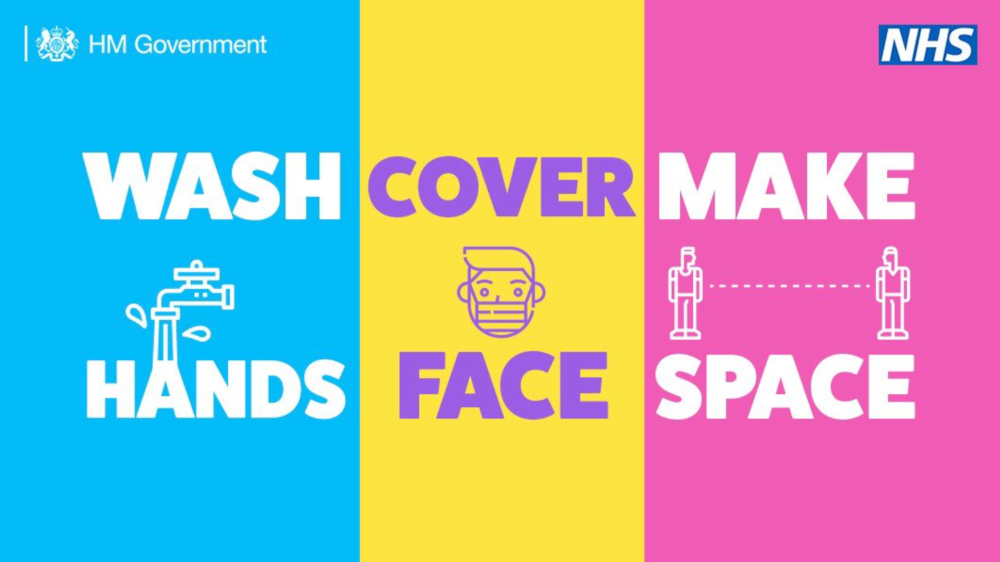
To reinforce the mitigation of risks the government has just unveiled some new buzzwords. To reinforce the last element, fines for those gathering in groups of 30 or more are increased from this week.
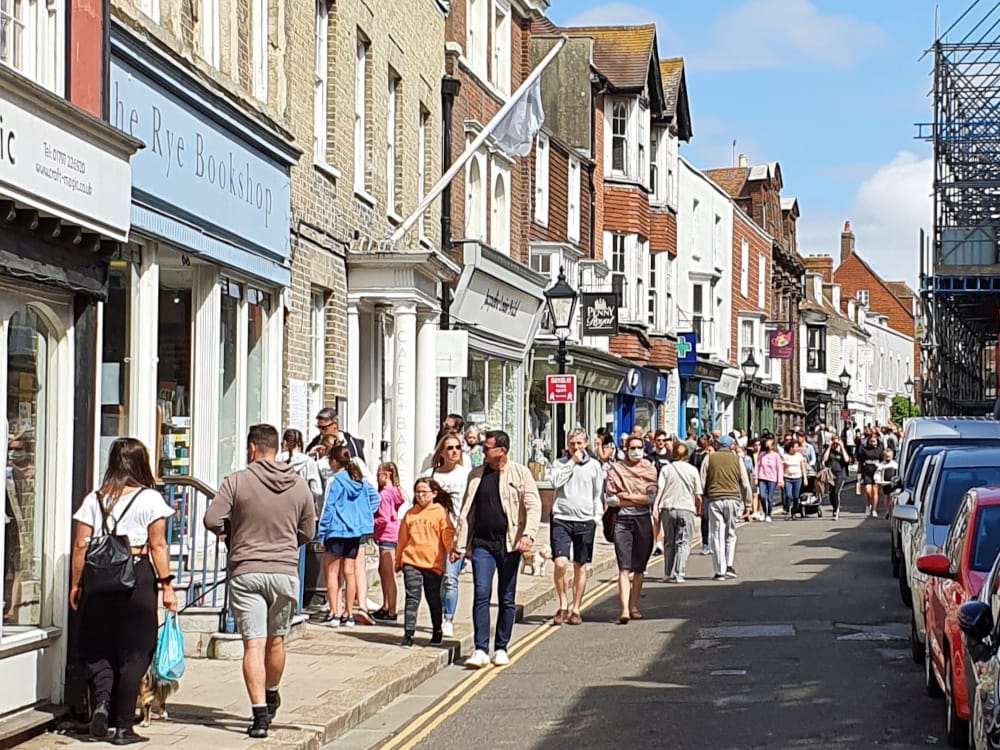
Even with the change of weather, it is possible to see large numbers of visitors to Rye not adhering to social distancing.
Looking to the immediate future and to the direct impacts of the pandemic, there are government expectations of rising employment from October as and when furlough ends. Some of our RMA volunteers suggest that locally there are people just "hanging on" economically. Our call for an outreach centre in Rye and District for social and employment services has so far fallen on deaf ears.
With so much of the NHS focused onto Covid-19, it is possible to get a local doctor video consultation, but a good deal of so called routine NHS treatment is being delayed, and there are now NHS predictions of a build up of longer term treatment waiting times, particular for some cancers, and for surgery such as hip and knee replacements.
This week the New Scientist publication reports on some interesting Covid-19 developments. First, data shows that people in Europe are less likely to die if they get Covid-19 compared with earlier in the pandemic, but the reasons are less clear. Secondly, blood plasma donated by people who have recovered from Covid-19 is being used with some sign of success, as a treatment for the infection. Lastly, in Hong Kong a healthy 33-year-old man is the first person confirmed to have caught the virus twice. As details of the case emerge from the University of Hong Kong, researchers say thoughtfully that "there is still much we do not know about Covid 19."