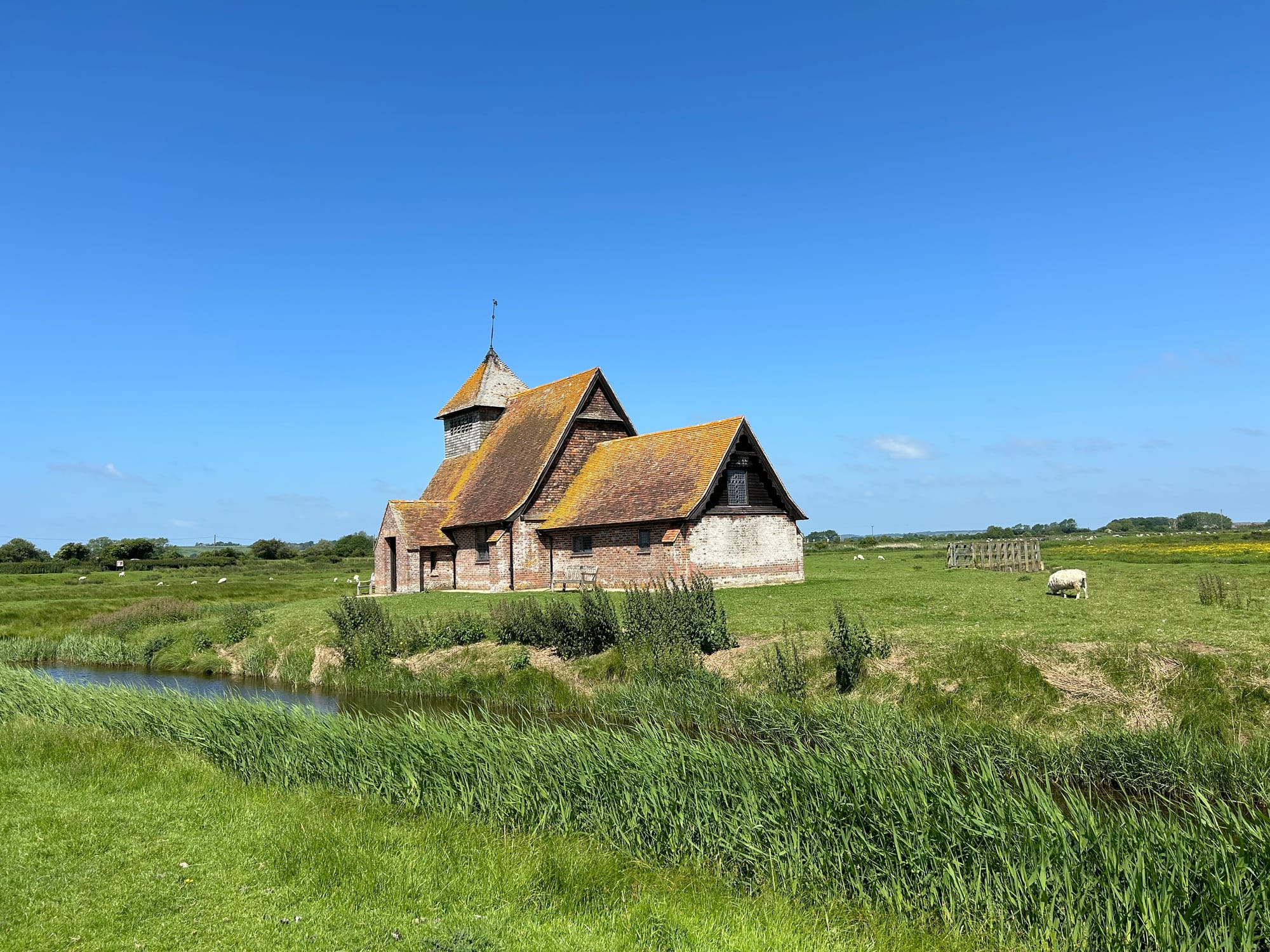
Romney Marsh can be a bleak and lonely but beautiful place. Typical of that is the church of St Thomas Becket, sitting alone surrounded by fields and streams, at Fairfield about three miles from Brookland. For many it's a sight as iconic as St Mary's Rye. All alone on the Marsh, something to look out for on the rail journey to Ashford.
The story connected to its foundation is that St Thomas Becket, Archbishop of Canterbury from 1162 until his murder in his own cathedral in 1170, was travelling across the marsh and fell into a ditch. As he was going under for the second time he prayed to St Thomas for help. It was at that moment a farmer was passing and pulled him to dry land. So the church was built as a symbol of the archbishop’s gratitude for his salvation.
Around 1200, a very basic building arose made from the traditional materials of lathe and plaster, and probably lime plastered or lime washed inside and out. This early church survived, almost miraculously intact, into the 18th century when bricks were used to enclose the original building and red clay tiles covered the roof. At the same time a new brick foundation was added.
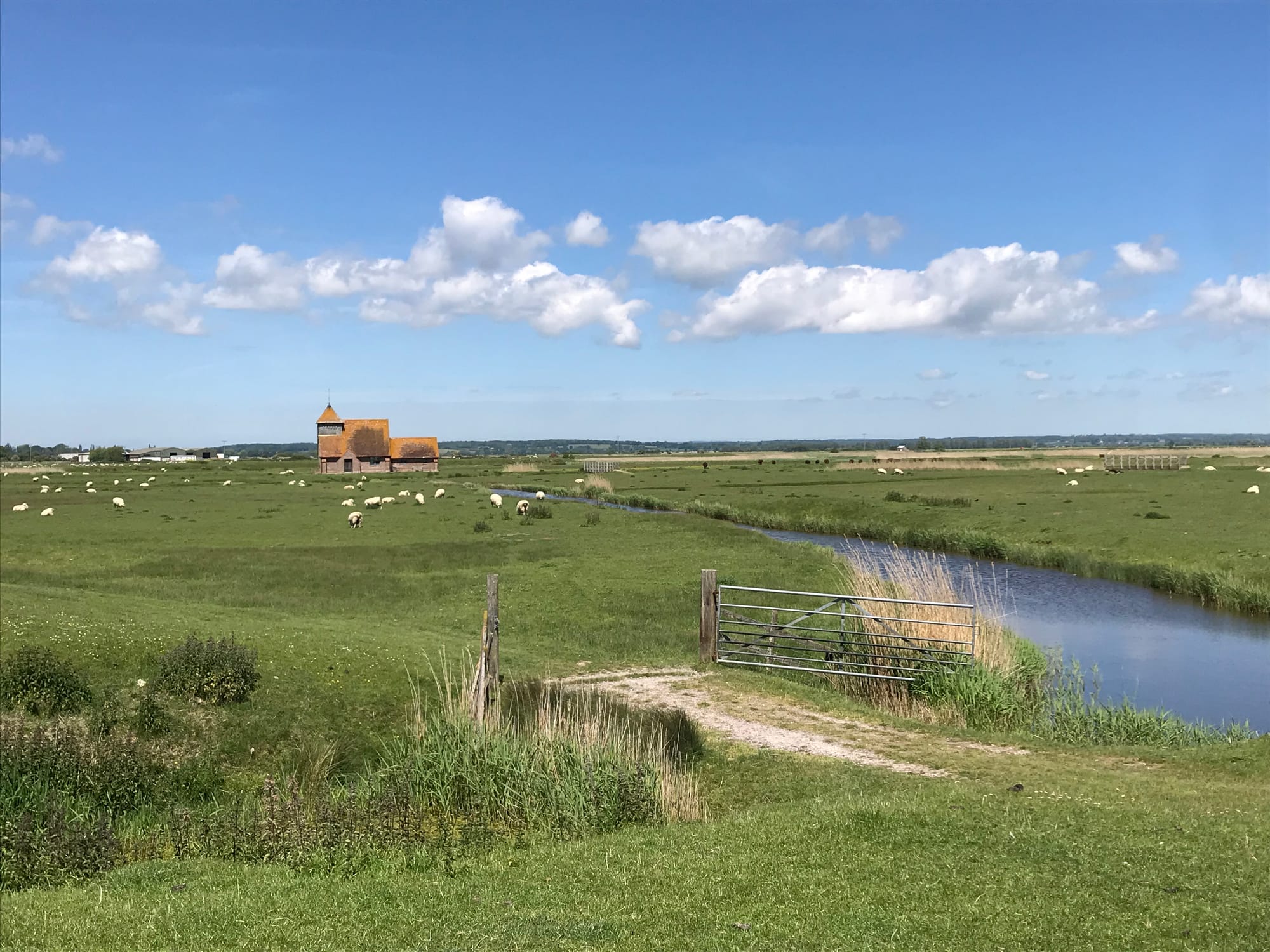
Although now standing isolated, there was at one time a village for the church to serve. It was lost, most probably for the same reason that many English villages were abandoned during the 14th century – the terrible scourge known as the Black Death. It is believed that in just two years between 1348-50 anything up to 45% of the population were killed by the plague.
Plague wasn’t the only killer on Romney Marsh. Stagnant water harbours many nasty bacteria capable of felling a man – or woman. There was also malaria carried by mosquitoes. Malaria, often called ague or marsh fever, was killing people into the 19th century. Indeed, mortality rates on Romney Marsh were about twice as high as in the villages surrounding it. Writing in the late 18th century, Edward Hasted the Kent antiquarian and writer tells us that "the airs and waters" of the marsh were "foul and fatal". We know from census returns for Fairfield in 1801 that its population was just 49.
Work has been carried out on the church over the centuries. During the early years of the 18th century the south wall was rebuilt with the chancel being reconstructed about 50 years later. At the end of that century a porch was added – no doubt much welcomed as a respite from the cold winds that blow in from the east.
In about 1800 the west and north walls were rebuilt. During 1912-13 almost the entire church was rebuilt because of the dangerous state of many of the medieval timbers. The north wall, bell turret, chancel and roof were all replaced and the foundation once more rebuilt. A causeway was constructed for access during floods. As many of the original materials as could reasonably be salvaged were used during the rebuilding.
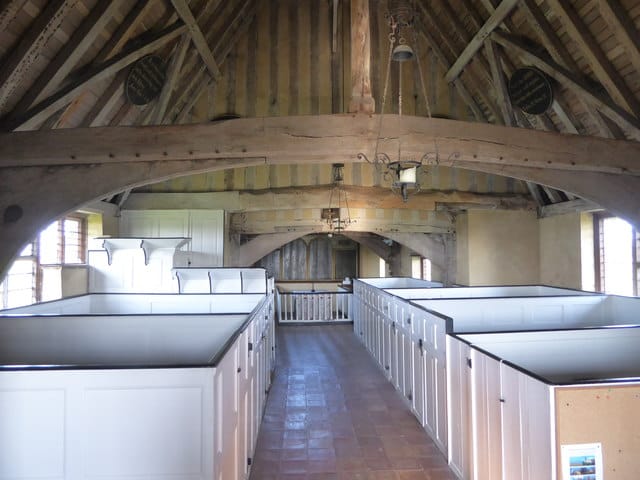
The church inside is pure Georgian with white painted box pews, plaques with biblical quotes around the walls and a triple decker pulpit - at the bottom was the clerk’s desk, in the middle the lectern and on top the pulpit for preaching and for giving a bird’s eye view of the congregation. The font is very unusual, indeed unique in Kent, in being seven sided. This is probably a reference to the seven sacraments, or alternatively the seven works of mercy or the seven deadly sins. Such fonts generally date from the 15th century, often paid for by prominent local families trying to ensure the supremacy of the Catholic faith over local superstitions. They are mostly found in East Anglia, where there are at least 22, so to find one in our part of the country is indeed a rarity.
For many years, attending services during winter and spring meant travelling by boat, because of flooding. The 1913 causeway largely solved that problem, but in very wet weather and high water the church can look marooned on its mound. The graveyard has no stones because of the floods. Records show that the last interment was that of Kate Tolhurst, a young domestic servant, who died in 1859.
As one may expect from such a photogenic building and location, the church has appeared in films and on television, especially in productions of Great Expectations as the church where Pip meets Abel Magwitch, the escaped convict. Set just after Christmas 1812, Pip is visiting the graves of his family when he is surprised by ‘"a fearful man, all in coarse grey, with a great iron on his leg. A man with no hat, and with broken shoes, and with an old rag tied round his head. A man who has been soaked in water, and smothered in mud, and lamed by stones, and cut by flints, and stung by nettles, and torn by briars; who limped and shivered, and glared and growled; and whose teeth chattered in his head as he seized me by the chin." It’s a wonder poor little Pip didn’t just die of fright on the spot! The actual church that inspired Dickens was St James’s at Cooling, also in Kent.