


Rye Academy, which runs the town's schools, is having to take some hard decisions, including scrapping plans for a new building, and Rye News' founder Kenneth Bird talks (below) to the Academy Trust's new Chief Executive about the changes.
Tim Hulme, Chief Executive Officer of the Rye Academy Trust, has been in position since September 1 2016, nearly five months, he told me when we met last Monday, January 23.
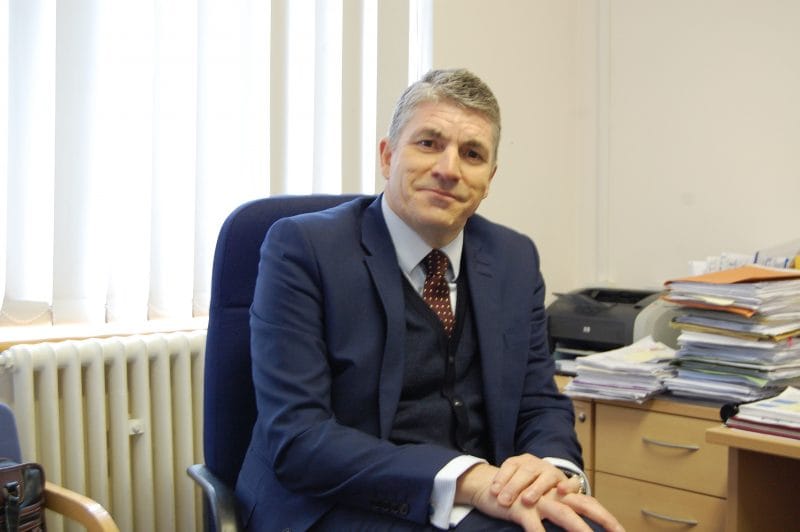
He brings with him a background not in education, but in business. Having qualified as a chartered surveyor, he worked in the pharmaceutical industry with Pfizer and more recently has developed skills and practised successfully in business recovery roles. He was recruited following Ann Cockerham’s retirement with the specific task of restoring the Trust to sound financial health.
He is responsible to a new board of trustees headed by Cllr Ian Potter as chairman. The governing body has been expanded to combine Rye College and the Studio School, reflecting their closer alignment. Further appointments are being canvassed following recent resignations of Jacqui Lait and Sue Schlesinger. There have been changes too in other key posts. Jo Townshend has retired owing to ill health from head of the Studio School (one of 30 experimental schools which was opened by then Education Secretary Michael Gove in 2014) , being replaced by Ian Gillespie in addition to his role as head of Rye College.
Despite good results achieved in recent years, the Trust has reached a watershed in financial terms. A report by the National Audit Office indicates schools face cuts of 8% in real terms by 2019-20 with increased costs in relation to higher contributions to national insurance and teachers’ pensions, the introduction of the “national living wage”, pay rises and the apprenticeship levy. There is no additional funding for these and funding per pupil is not rising in line with inflation. Government proposals for a new funding formula for schools in 2018-19 is expected to redistribute money from inner-city schools to rural areas but in the meantime, this small multi academy trust of three schools in a rural area, must ensure its operating model gains best value from public funds in relation to outcomes for all learners.
Also before Christmas came an adverse Ofsted report which found that the Studio School "required improvement", a rating just above that given for an institution placed in "special measures".
The need for change was evident. Tim Hulme’s first important task was to prepare a new business plan, reviewing objectives against the resources available. This has been submitted to the Department of Education and the Education Funding Agency, as part of an application for £2 million of urgent additional funding. A response from government, expected by the end of February, will determine the future of this £6 million turnover business.
The plan seeks to ensure that the core subject curriculum, the staffing and available resources are all fit for purpose. A period of consolidation is envisaged from 2017/2019. A new curriculum pathway will provide learning access to the creative industries and employment in the sports and leisure and front of house hospitality industries, with two year apprenticeship schemes being introduced.
There is a need too for bringing the older buildings in the centre of the college complex up to date with a refurbishment programme estimated to cost £500,000, the subject of a separate grant application. Realistically, he accepts there is no prospect of enlarging the basic school footprint onto the vacant Lower School site as had been once mooted.
In promoting transformation, Tim Hulme recognises fully the important role played by stakeholders, primarily the staff, the parents, and local employers, but also the whole community. With the goodwill from these quarters, he has the determination to see the Academy Trust rise to new heights as a beacon of excellence.
Photo: Kenneth Bird


