


On Tuesday, January 30, I wrote to East Sussex County Council (ESCC), copying Sally-Ann Hart MP. I wrote on behalf of a Facebook group that, at the time, had about 800+ members. It’s called “Hastings and Rother Potholes – The Great Zig-Zag Drive”, and it does what it says on the tin! It’s a forum for discussion of our dangerous and dilapidated roads. Founded by Jacqueline Morrison, it now numbers 1,600 members and is buzzing with enquiry and exasperation every day.
The letter I wrote was kindly reproduced by Rye News. It took a while to get a response from ESCC, but when I received one, it was informative but essentially defensive, as is perhaps understandable. I don’t aim to be a spokesman for Conservative-run ESCC, but since you and I are encountering potholes every day, I expect you’d like to know the council’s responsibilities. So I’ve tried to boil it all down, below.
The ESCC letter stated that 20,000 potholes have been repaired this year and that three times as many gangs are deployed fixing them. The letter also highlighted that the council is not required by law to repair all potholes and defects, as that would be “prohibitively expensive” and “place an even greater burden on taxpayers.” The logic stands, but I know many people will also feel purchasing a new tyre or getting their tracking re-aligned is also a ‘great burden’...
Nonetheless, officers at ESCC have a job to do and criteria to apply. Some of these were also outlined and may be of interest. The new contractor, Balfour Beatty Living Places (BBLP) were awarded a £297m contract last spring, and have signed up to quality assurance guarantees and a commitment to ‘right first time’ repairs. BBLP monitor their own work and ESCC highways stewards have oversight too, with major roads being inspected once a month and lesser roads being inspected once every six months. You and I augment this scheme by reporting defects and potholes too.
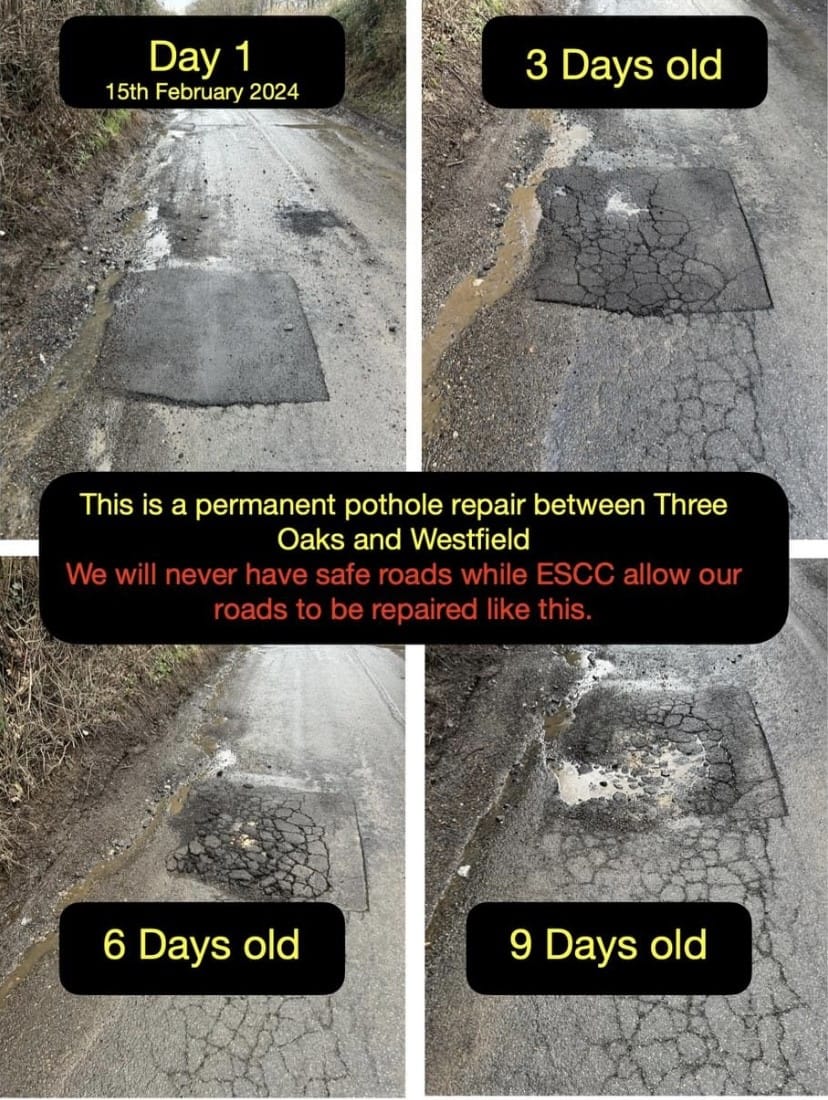
There’s also a new technique for repairs, whereby the contractor cuts out a square from the tarmac a minimum distance of 250mm from the ragged edge of the hole. This is supposed to be sealed at the edges and is apparently a more robust fix. So, when you see a square patch, this should be a recent repair using the new technique. These ‘square repairs’ differ from temporary emergency repairs, which should be marked with a ‘T’. A permanent repair should be made within 28 days. Once a repair has been completed, that is guaranteed by the contractor for 52 weeks. If the repair fails in this time, the contractor is liable for that re-repair at their own cost. So, the taxpayer doesn’t pay at that point, but naturally, that cost will have been factored in to BBLP’s contract offer to ESCC. In effect, we have already paid. The question is, are we getting value for money? That is a very, very hard question to answer. But the research of Pete Munro, Clive Meekham and Richard Telford, other members of the Hastings Potholes group, does perhaps give some cause for concern...
The civic minded trio have been diligently monitoring the state of potholes in the area, particularly those that have been repaired. Last week Mr Munro posted a photo which depicted a recently repaired pothole between Three Oaks and Westfield. The pristine repair was photographed on ‘Day 1’ and dated 15th Feb. Over the coming days, successive photos were taken at days three, six and nine in the life of the repaired pothole. By day nine, the surface was already crazed and broken and it was clear that it would very soon require repairing again. This, it should be said, was a ‘square repair’ of the type we’re told is more durable. It was not sealed at the edges, however. So, are repairs being made effectively? Are the new quality assurance standards sufficiently rigorous? And are they being upheld? We owe thanks to Mr Munro and his colleagues for highlighting these questions, which will hopefully hasten a resolution.
In the meantime, in a cost of living crisis, having to shell out for a new tyre for our indispensable cars is not something any of us want to contemplate. The claims process has understandably, therefore, been much discussed. The council’s actions are governed by the Highways Act 1980, and there’s a statutory duty with respect maintenance and a statutory defence against claims. This is how it works.
If ESCC can show that they have taken “reasonable care” to maintain the highway in a condition that is safe for users by carrying out robust inspections, it cannot be held liable. If ESCC were not aware of a defect again, it cannot be held liable. If it may be proven that ESCC was aware and did not repair the defect in a specified time, it may be held liable. So only where there’s proven negligence or breach of a statutory duty is ESCC liable. That’s why it’s imperative to keep reporting holes and to retain the proof of the report. It doesn’t take long, and can be done here: https://live.eastsussexhighways.com/report-problem/making-claim-east-sussex-highways
The other crucial aspect is the role of central government, and in particular, levels of funding. In response to my letter, I received a polite note from the office of Sally-Ann Hart MP. It comprised the usual smokescreen of impenetrable raw data that seems to pass for political communication these days. A list of large numbers is rarely illuminating, particularly as some seemed contradictory and others didn’t immediately tally with what was in the Conservative literature landing on our doorsteps. Moreover, it doesn’t matter how much has been spent, and how much is promised, because even the most colossal sum seem utterly insignificant in contrast to our everyday driving reality. That reality tells us that things have been allowed to deteriorate to such an extent that remedial works clearly cannot be made fast enough. We’re left with roads that are dangerous to vehicles, cyclists, bikers and pedestrians. When the tourists arrive to visit our beautiful medieval town, they’ll be confronted with shameful medieval roads too. It’s the same in Hastings and surrounding areas.
Tellingly, the one question I did not have addressed by either ESCC or Mrs Hart was, this: what is the long term strategy to address this problem? I acknowledge that weather is already an issue and likely to be a bigger one in coming years, but throwing money at the problem just before an election is not a strategic response. It is emblematic of the short-term, quick fix, partisan mentality that confounds Britain. We need to get back to consensus politics and long term policy development and implementation. But that will never be achieved with our winner-takes-all electoral system. We need politics with generational vision that prioritise people, not the fortunes of political parties.
A shovel full of asphalt in the hole may be cheaper in the short term, but in the long run it’s a road to ruin. This coming election, we have the opportunity to stop the traffic and fix the road for good.
Email: ryeguylibdem@gmail.com
Instagram: guyharris_libdem


